
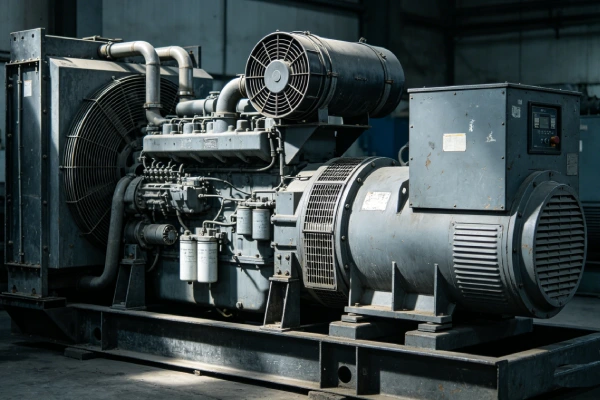
Open frame vs closed frame generator — the difference comes down to the enclosure. An open frame generator has exposed engine and components; a closed frame generator (also called a cased or enclosed generator) wraps them in a sound-dampening housing. That single design choice affects open frame generator noise, maintenance access, portability, weather protection, and price.
Neither type is better in every situation. This guide compares them by what actually changes your buying decision, then maps each type to home backup, camping and RV use, and job sites.
Before anything else: a closed frame does not make a generator safe to run indoors, in a garage, or in any enclosed space. All fuel-burning portable generators must run outdoors, away from windows, doors, and vents. Exhaust contains lethal carbon monoxide.
Open Frame vs Closed Frame Generator: Quick Comparison
| Feature | Open Frame Generator | Closed Frame Generator |
|---|---|---|
| Noise | Less sound insulation; engine noise escapes | Enclosure dampens engine noise |
| Maintenance access | Components exposed; oil, plug, filter easy to reach | Often requires removing side panels |
| Portability | Lighter for the same output; no housing | Compact shape, but housing adds weight |
| Weather protection | Exposed to dust and rain; needs shelter | Housing helps, but is not automatically weatherproof |
| Price for the same output | Usually lower | Usually higher — the enclosure adds cost |
| Best fit | Job sites, higher output on a budget | Home backup, camping, RV, noise-sensitive sites |
Two clarifications that trip up most buyers:
- Closed frame does not mean inverter. Frame design and inverter technology are separate. An open frame generator can be an inverter generator, and a closed frame generator can be a conventional one. Check the model’s specs, not the housing.
- Noise ratings are not category-wide. There is no fixed dB number for “open frame” or “closed frame.” Noise depends on the specific model, load, engine speed, and how it was measured.
Open Frame Generator Noise vs Closed Frame Generator Noise
This is the question most buyers actually have, so it deserves a direct answer — with the caveat that the numbers below are typical reference ranges, not specifications for any particular model.
| Typical reference | Open frame | Closed frame |
|---|---|---|
| Light load / eco mode | Roughly mid-60s dB and up | Roughly high-40s to mid-50s dB |
| Full load | Noticeably louder | Louder than eco, still dampened by housing |
Treat those as orientation only. The reliable way to compare is to read the specification table and the manual for each model and check four things:
- The stated dB figure — and whether the listing gives one at all. A single number with no conditions is a marketing figure.
- Measurement distance — commonly 7 m, but not always. A figure at 1 m is not comparable to one at 7 m.
- Load condition — eco mode, half load, or full load.
- Test standard — if none is stated, cross-model comparison is unreliable.
On perceived loudness: a 10 dB difference is a tenfold increase in sound intensity. Most listeners perceive that as roughly twice as loud, but it is an approximation, not a rule. A quieter generator with an annoying whine can be more irritating than a slightly louder one with a smoother tone — which is why listening to a recording or in person still matters.
Open Frame Generator for Home Backup: Does It Work?
It can, but noise is usually the deciding factor. If you are buying for home backup and your neighbors are within earshot, a closed frame generator is generally the more practical choice. If your load is large — well pump, HVAC, or a whole-panel setup — the cost gap widens, and an open frame generator may be the realistic option for the output you need.
Before choosing either, work out two numbers: running watts of everything you need on at once, and starting watts for motor-driven loads. Then check:
- Where it will sit. Outdoors, with the manufacturer’s required clearance from the house, windows, and vents.
- How it connects. A portable generator feeds your home through a transfer switch or an approved interlock, installed to local code. That is an installation decision, separate from the enclosure.
- Local noise rules. Some areas restrict generator hours or levels during outages.
A portable generator is not a substitute for a permanently installed standby system. If you need automatic backup, that is a different product category.
Open Frame Generator for Camping and RV Use
Here the answer usually flips: a closed frame generator is the better fit for most campgrounds and RV setups, because noise limits are common and space is tight.
Before buying for camping or RV use, check:
- Campground rules. Limits vary by site. Do not assume a closed frame model is accepted everywhere, or that an open frame model is refused everywhere — check the specific site.
- Your RV’s receptacle. Commonly 30A or 50A. Confirm the generator’s outlets match what your RV needs.
- Grounding. RV hookups have specific grounding expectations; confirm the generator is intended for RV connection.
- Weight and storage. A closed frame unit is compact but often heavy — check the actual weight against how you will lift it.
An open frame generator can work for dispersed camping or job-site-adjacent use where no one is nearby, but it is a poor default for established campgrounds.
Open Frame vs Closed Frame Generator for Job Sites
For construction and job sites, an open frame generator is usually the sensible pick. Components are exposed, so routine service — oil, spark plug, air filter — is faster. Output per dollar is better at higher wattages. Noise matters less when the site is already loud.
What to check: continuous output for your tools, whether the site has noise restrictions, how you will transport it (many open frame units have wheel kits), and whether the unit will be left exposed to rain or dust.
Is a Closed Frame Generator Weatherproof?
No. This is one of the most common assumptions, and it is wrong. A closed frame generator has a sound-dampening housing, not a waterproof one. Rain, hose water, and standing water can still enter through vents and damage the unit or create a shock risk.
Follow the manual for weather exposure limits, keep required ventilation clear, and use only manufacturer-approved covers or shelters. Never run any portable generator indoors, in a garage, or in a partially enclosed space — including a closed frame model.
What to Check Before Buying an Open Frame or Closed Frame Generator
- Power: running watts versus your load; starting watts for motors.
- Noise: stated dB, distance, load condition, and test standard — not a category label.
- Maintenance: access to oil fill, spark plug, and air filter. On closed frame models, find out whether panels must be removed.
- Portability: actual weight, handles, wheels.
- Weather: whether the model is intended for exposed outdoor use.
- Connection: receptacle types, and whether the model is intended for RV or transfer-switch use.
- Support: parts availability and warranty terms for your region.
Frequently Asked Questions
Is an open frame generator louder than a closed frame generator?
Usually yes, for models of similar output and engine design, because the housing dampens noise. But there is no fixed dB figure for either category — compare the stated rating, measurement distance, and load condition for the specific models.
Is a closed frame generator always an inverter generator?
No. Enclosure and inverter technology are independent. Open frame inverter generators and closed frame conventional generators both exist. Check the model’s specifications.
Which is better for home backup — open frame or closed frame?
A closed frame generator is usually the better fit where noise matters. An open frame generator can make sense for higher output on a tighter budget, provided you have calculated your running and starting watts and confirmed where it will run.
Can a closed frame generator run in the rain?
Do not assume so. The housing dampens sound, not water. Follow the manual’s weather limits and keep ventilation clear.
Is an open frame generator suitable for camping?
Usually not for established campgrounds with noise limits. Check the site’s rules and the model’s stated noise rating first.
Final Verdict
Choose an open frame generator for job sites, high output on a budget, and easy service access. Choose a closed frame generator for home backup where neighbors are close, for camping and RV use, and anywhere noise is the constraint.
Ignore the category label and compare the specification sheet: running watts, stated dB with its distance and load, maintenance access, weight, and weather limits. And whichever you buy, run it outdoors only.
Related Reading
- Inverter vs Conventional Generator — power quality and electronics compatibility
- Generator Starting Watts vs Running Watts — load calculations before you choose an enclosure
- Generator Won’t Start — 7 Common Mistakes & Fixes — fault symptoms and safe checks
- Quiet Generator Buying Guide — how quiet is quiet enough, and model-level noise comparisons