
📅 Last Updated: July 15, 2026 | Troubleshooting procedures verified for 2026 models.
UV light ice makers sound high-tech. But if you think the UV light means you never have to clean the machine again—you have been misled.
Here is the truth about UV lights in ice makers:
✅ UV kills bacteria in the water that passes through the UV chamber.
❌ UV does NOT clean the reservoir walls, water lines, or ice bin.
❌ UV does NOT remove biofilm or scale that is already growing in the lines.
❌ UV does NOT replace manual cleaning. You must still clean the unit monthly.
If you buy a UV ice maker and do not manually clean it, mold will still grow. UV light is not a shortcut—it is a supplement.
🔴 The Golden Rule of UV Ice Makers
UV light is not a cleaning substitute—it is a cleaning supplement.
If you do not clean your unit regularly, the UV light is useless. UV kills bacteria in the water. It does NOT clean surfaces. 80% of UV ice maker problems are cleaning-related—not UV-related.
⚡ 30-Second UV Ice Maker Diagnostic Card
| Symptom | What to Check | Most Likely Fix |
|---|---|---|
| UV indicator light is off | UV bulb or control board | Replace bulb or board ($10–$30) |
| Mold in reservoir despite UV | UV does not clean surfaces | Clean unit manually (30 minutes) |
| Ice tastes bad despite UV | Biofilm in water lines | Descale and clean unit |
| UV bulb over 1 year old | Bulb degrades over time | Replace UV bulb ($10–$30) |
| Unit keeps growing mold | UV not reaching water lines | Clean lines. UV cannot fix biofilm. |
Quick Answer: Diagnostic Flowchart
text
Ice maker with UV light — not working / still growing mold
    │
    ├── Is there visible mold or slime in the reservoir?
    │   ├── YES → UV light does not clean surfaces. Clean the unit manually.
    │   │            UV is not a substitute for cleaning.
    │   └── NO → Continue ↓
    │
    ├── Is the UV indicator light off?
    │   ├── YES → The UV bulb or control board has failed.
    │   │            Check if the bulb can be replaced.
    │   └── NO → Continue ↓
    │
    ├── Is the ice tasting bad or musty?
    │   ├── YES → The water lines may have biofilm. Clean and descale.
    │   └── NO → Continue ↓
    │
    └── Is the unit over 1 year old with the original UV bulb?
        ├── YES → UV bulbs degrade over time. Replace the bulb.
        └── NO → The unit should be working. Clean it anyway.
UV Light: What It Actually Does (and Doesn’t Do)
What UV light does:
- Kills bacteria in the water that passes through the UV chamber
- Reduces the number of microorganisms in the water
- Improves ice cleanliness (if the unit is already clean)
What UV light does NOT do:
- Clean the reservoir, water lines, or ice bin
- Remove scale or mineral deposits
- Kill mold that is already growing in the lines
- Remove plastic taste or chemical taste
- Prevent the need for regular cleaning
- Work indefinitely—bulbs degrade over time
The bottom line: UV light is a nice extra feature. But it does not replace cleaning. If you are buying an ice maker with UV light, expect to still clean it regularly.
📌 UV Ice Maker: Is It Worth the Extra Money?
This is the #1 question we get. Here is the simple answer:
| Your Situation | Verdict |
|---|---|
| You are willing to clean the unit manually every month | ✅ Yes, worth it. UV is a nice bonus. It reduces bacteria in the water. |
| You do not want to clean the unit—you expect UV to do the work | ❌ No, not worth it. You will be disappointed. UV does not replace cleaning. |
| You or your family have immune system issues or young children | ✅ Yes, worth the extra cost. UV provides an extra layer of protection. |
| You are on a tight budget | ❌ Skip it. Save the money. Manual cleaning is more effective than UV. |
| You are buying a cheap unit (under $100) with “UV” | ❌ Not worth it. The UV light is likely low power or a gimmick. |
One-sentence summary: UV light is a supplement, not a substitute. If you are not willing to clean your unit every month, UV will not save you. Spend your money on a better-built unit instead.
Quick Brand Reference
| Brand / Type | UV Feature | Most Common Issue | First Step |
|---|---|---|---|
| GE Opal (with UV) | UV-C light in reservoir | Mold despite UV | Clean unit manually + descale |
| Samsung (with UV) | UV-C in water line | UV bulb failure | Check indicator light. Replace bulb. |
| LG (with UV) | UV in water reservoir | Mold in reservoir | Clean reservoir manually |
| Countertop with UV (quality) | UV in water line or reservoir | UV stops working after 6–12 months | Replace UV bulb |
| Countertop with UV (cheap) | UV may be fake or low power | No visible effect | Clean unit. UV may not work. |
Note: If you bought a cheap unit under $100 with “UV,” the UV is likely a gimmick. Do not rely on it. Manual cleaning is your only reliable option.
5 Common UV Ice Maker Problems & Fixes
Problem #1: Mold Still Growing Despite UV Light (40% of cases)
What you see: The unit has UV light, but there is still mold, slime, or black gunk in the reservoir or water lines.
What causes it: UV light only treats the water that passes through the UV chamber. It does NOT clean the reservoir walls, water lines, or ice bin. Mold grows on surfaces—not in the water.
Why this happens: Owners assume UV means they do not need to clean the unit. This is false.
Fix:
- Unplug the unit.
- Remove the water reservoir.
- Wash with warm soapy water. Scrub away any visible mold.
- Use a 1:10 vinegar-to-water solution to descale the unit.
- Run a full cycle with the vinegar solution. Let it sit for 20–30 minutes.
- Rinse thoroughly. Run 2 full cycles with clean water.
- Continue cleaning the unit monthly. UV is not a substitute for cleaning.
If the problem persists: There may be biofilm in the water lines. Replace the water lines if possible.
Prevention: Clean the unit monthly. Drain the reservoir after each use.
Problem #2: UV Indicator Light Is Off (25% of cases)
What you see: The UV indicator light on the unit is not on. The UV light is not working.
What causes it: The UV bulb has burned out, or the control board has failed.
Why this happens: UV bulbs have a lifespan. Most last 6–12 months. They burn out like any other bulb.
Fix:
- Check the manual for the UV bulb replacement procedure.
- Purchase a replacement UV bulb ($10–$30).
- Install the new bulb (usually a simple twist or plug-in).
- Test the unit. The indicator light should come on.
If the problem persists: The control board may have failed. This is rare. If the unit is over 2 years old, consider replacing it.
Prevention: Mark your calendar to replace the UV bulb every 6–12 months.
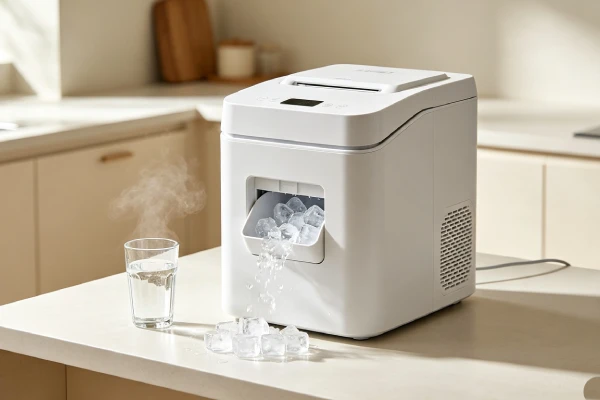
Problem #3: Ice Tastes Bad Despite UV Light (15% of cases)
What you see: The UV light is on and working. But the ice still tastes bad, musty, or chemical.
What causes it: The UV light kills bacteria in the water. It does NOT remove scale, biofilm, or chemical tastes. The water lines are dirty.
Fix:
- Descale the unit with a 1:10 vinegar-to-water solution.
- Run 2–3 cycles with clean water to flush the lines.
- If the taste persists, replace the water lines (if possible).
- Use filtered water to improve taste.
If the problem persists: The plastic components may be degrading. Check for black flecks in the ice.
Problem #4: UV Bulb Needs Replacement (10% of cases)
What you see: The UV light is dim or not working at all. The unit is over 6 months old.
What causes it: UV bulbs degrade over time. Even if they are still lit, they may not be producing enough UV light to kill bacteria.
Fix: Replace the UV bulb ($10–$30). Most bulbs are simple to replace—check your manual.
Prevention: Replace the UV bulb every 6–12 months, even if it still appears to be working. The UV output degrades over time.
Problem #5: Unit Has Other Failures (Sensor, Leaks, Noise) (10% of cases)
What you see: The unit has UV light, but it is also experiencing other issues—sensor failures, leaks, grinding noises.
What causes it: The UV feature is separate from the core ice maker components. UV does not prevent sensor failures, pump failures, or compressor failures.
Fix: The UV feature is not the problem. Troubleshoot the specific failure (see our other guides).
Quick Diagnostic Checks (Before You Call a Pro)
Step 1: Check the UV Indicator Light
Is the UV indicator light on? If it is off, the UV bulb or control board has failed.
Step 2: Check for Visible Mold
Look in the water reservoir. Is there visible mold or slime? If yes, the UV is not cleaning surfaces. Clean the unit manually.
Step 3: Check the Ice Taste
Does the ice taste bad, musty, or chemical? If yes, the water lines have biofilm or scale. Descale the unit.
Step 4: Check the UV Bulb Age
Is the unit over 6 months old? If yes, the UV bulb may need replacement.
Step 5: Check the Unit Cleanliness
When was the last time you cleaned the unit? If the answer is “never” or “months ago,” the UV cannot compensate for a dirty unit.
Step 6: Test with Filtered Water
Use filtered or bottled water. Does the ice taste better? If yes, the problem is your water supply—not the UV.
Component-Level Failure Explanation
UV Bulb
Typical lifespan: 6–12 months. Degrades over time. UV output decreases even if the bulb still lights up. Replace annually. This is a wear part.
UV Control Board
Typical lifespan: 3–5 years. Fails due to power surges or moisture intrusion. This is a wear part—age-related.
Water Lines
Lifespan: 2–5 years. Can harbor biofilm that UV cannot reach. This is maintenance-dependent.
Reservoir
Lifespan: Indefinite with maintenance. Can grow mold on surfaces. UV does not clean surfaces. This is maintenance-dependent.
When to Repair vs Replace Your UV Ice Maker
| Situation | What To Do |
|---|---|
| UV indicator light off, unit under 2 years old | ✅ Replace the UV bulb ($10–$30). |
| UV indicator light off, unit over 2 years old | ⚠️ Consider replacing the unit if the board is dead. |
| Mold in reservoir despite UV | ✅ Clean the unit manually. UV is not a substitute for cleaning. |
| UV bulb over 1 year old | ✅ Replace the bulb ($10–$30). |
| Unit over 3 years old, multiple failures | ❌ Replace the unit. Repairs exceed value. |
| Cheap unit under $100, UV not working | ❌ UV is likely a gimmick. Clean manually. Do not repair. |
Risk If Ignored
- Mold exposure: Ignoring mold in the reservoir means you are consuming mold spores.
- Bacterial growth: UV only treats water in the chamber. Bacteria can grow elsewhere.
- Health risks: Mold and bacteria can cause stomach issues and allergic reactions.
- Scale damage: Scale builds up and damages the pump and compressor.
Prevention Advice (What Actually Works – and What Doesn’t)
What Actually Extends Life and Keeps Ice Clean:
- Clean the unit monthly. UV is not a substitute for cleaning. This is the single most important thing you can do.
- Drain the reservoir after each use. Standing water breeds mold.
- Use filtered water. This reduces scale and improves taste.
- Replace the UV bulb every 6–12 months. UV output degrades over time.
- Wash the ice bin weekly. This prevents odors and mold.
- Descale the unit quarterly. Scale reduces efficiency.
What Sounds Good But Does NOT Work:
- “UV light means I never have to clean the unit”: False. UV does not clean surfaces. You must still clean the unit regularly.
- “The UV bulb lasts forever”: False. UV bulbs degrade and must be replaced every 6–12 months.
- “UV removes scale”: False. UV does not remove mineral deposits. You must descale.
- “UV kills all bacteria everywhere”: False. UV only kills bacteria in the water that passes through the chamber. It does not kill bacteria on surfaces or in the lines.
Technician Conclusion
Here is the hard truth from the workbench: UV light is a nice feature—but it does not replace cleaning.
- UV kills bacteria in the water. That is it.
- UV does not clean surfaces. Mold grows on surfaces.
- UV does not remove biofilm or scale. You must descale.
- UV bulbs degrade and must be replaced every 6–12 months.
- If you do not clean your unit manually, UV will not save you.
What experienced technicians do in this situation:
We ask: “When was the last time you cleaned the unit?” If the answer is “never” or “months ago,” we clean it. We tell the customer: “UV light is a nice feature, but it does not replace cleaning. You still need to clean the unit monthly. If you do not clean it, the UV will not save you.”
What most owners regret not knowing earlier:
They regret not knowing that UV does not replace cleaning. They regret not knowing that UV bulbs need to be replaced every 6–12 months. They regret not knowing that mold grows on surfaces, not in the water. They regret paying extra for a feature that did not solve their mold problem because they were not cleaning the unit. They regret buying a cheap UV unit with a fake UV light.
Our final advice: If your ice maker has UV light, treat it as an extra feature—not a replacement for cleaning. Clean the unit monthly. Replace the UV bulb annually. Use filtered water. If the unit still grows mold, the UV is not reaching the problem areas—and you need to clean more thoroughly. If you are buying a new ice maker, do not pay extra for UV unless you already clean your unit regularly. UV is a supplement—not a substitute.
FAQ
Q1: Does UV light actually work in ice makers?
Yes, UV light kills bacteria in the water that passes through the UV chamber. But it does NOT clean surfaces (reservoir walls, water lines, or ice bin). It is a supplement to cleaning, not a replacement.
Q2: Why does my UV ice maker still grow mold?
UV light does not clean surfaces. Mold grows on the reservoir walls and water lines—not in the water. UV only treats the water in the chamber. You must still clean the unit manually.
Q3: How long does a UV bulb last in an ice maker?
Most UV bulbs last 6–12 months. Even if the bulb still lights up, the UV output degrades over time. Replace the bulb annually.
Q4: How do I know if the UV light is working?
Check the UV indicator light on the unit. If it is on, the UV is powered. If the unit is over 1 year old, the bulb may still be on but not producing enough UV—replace it.
Q5: Can I replace the UV bulb myself?
Yes. Most UV bulbs are user-replaceable. Check your manual for the specific procedure. Bulbs typically cost $10–$30.
Q6: Is UV worth paying extra for in an ice maker?
Only if you already clean your unit regularly. UV is a supplement to cleaning—not a replacement. If you do not clean your unit, UV will not save you. If you have immune system issues or young children, UV can provide extra protection.
Q7: Why does my ice still taste bad even with UV?
UV kills bacteria. It does not remove scale, biofilm, or chemical tastes. If the ice tastes bad, the water lines are dirty. Descale and clean the unit.
Q8: Does UV remove scale?
No. UV does not remove mineral deposits. You must descale the unit regularly.
Q9: Is UV ice maker better than a regular ice maker?
UV can help reduce bacteria in the water, but it does not make the unit more reliable or longer-lasting. The core ice maker components (compressor, pump, sensors) are the same. UV is an extra feature—not an upgrade to reliability.
Q10: Should I buy an ice maker with UV light?
| Your Situation | Verdict |
|---|---|
| You clean the unit manually every month | ✅ Yes. UV is a nice bonus. |
| You do not want to clean the unit | ❌ No. You will be disappointed. |
| You have immune system issues or young children | ✅ Yes. Provides extra protection. |
| You are on a tight budget | ❌ Skip it. Manual cleaning is enough. |
| You are buying a cheap unit (under $100) with UV | ❌ No. The UV is likely a gimmick. |
Related Reading
- GE Opal 2.0 Problems: $0 Fix vs $300 Repair
- Most Reliable Ice Maker 2026: 5 Brands Ranked by Failure Rates
- Ice Maker with Water Dispenser: One Works, One Doesn’t? Fix Guide
- Ice Maker Tastes Like Plastic? $0 Fix vs $200 Replacement
- GE Ice Maker Making Hollow Ice? 7 Causes & Fixes (Opal & Built-In)
- Best Budget Ice Maker 2026: 5 Reliable Units Under $200