
📖 Is This Guide for You?
You live at high altitude and your ice maker is slower or making softer ice → Keep reading.
You’re shopping for an ice maker for a mountain cabin or high-altitude home → Keep reading.
Your ice maker is making grinding noises → See our [Ice Maker Grinding Noise? Fix or Replace?] guide.
Your ice maker is not making any ice at all → See our [Ice Maker Not Working? 7 Causes & Fixes] guide.
This is a HIGH ALTITUDE diagnosis guide — written from the workbench based on real field experience.
⛰️ High Altitude = Lower Freezing Point = Slower Ice
At high altitude, the freezing point of water drops — the unit has to get colder to freeze water.
| Altitude | Freezing Point | Ice Production Speed | Ice Hardness |
|---|---|---|---|
| Sea level | 32°F (0°C) | Normal | Hard |
| 5,000 ft | ~31°F (-0.5°C) | 10–20% slower | Slightly softer |
| 8,000 ft | ~30°F (-1°C) | 20–30% slower | Noticeably softer |
| 10,000 ft | ~29.5°F (-1.5°C) | 30–40% slower | Very soft |
The machine isn’t broken — it’s just working harder.
If you’re at high altitude and the ice is slow and soft — that’s normal, not a defect.
🔍 High Altitude: Normal vs Real Problem
| Symptom | Normal at Altitude? | Actually a Problem? |
|---|---|---|
| Slower ice production | ✅ Normal | ❌ Not necessarily |
| Softer ice, melts faster | ✅ Normal | ❌ Not necessarily |
| Less ice produced per cycle | ✅ Normal | ❌ Not necessarily |
| Grinding or growling noise | ❌ NOT normal | ✅ Real problem — frozen unit! |
| No ice at all | ❌ NOT normal | ✅ Real problem — mechanical issue |
| Unit is very hot to the touch | ❌ NOT normal | ✅ Real problem — dirty coils or failing compressor |
Remember: If the unit is making ice — even if it’s slow and soft — it’s working. No ice or grinding = real problem.
💡 The Hard Truth: High Altitude Changes How Ice Freezes
At high altitude, two things happen that affect ice makers:
- Lower boiling point — water boils at a lower temperature, which affects how the compressor works
- Lower freezing point — water freezes at a slightly lower temperature, meaning the unit has to work harder
| Altitude | Boiling Point | Freezing Point | Ice Maker Effect |
|---|---|---|---|
| Sea level | 212°F (100°C) | 32°F (0°C) | Normal operation |
| 5,000 ft | 203°F (95°C) | ~31°F (-0.5°C) | Slightly slower production |
| 8,000 ft | 197°F (92°C) | ~30°F (-1°C) | Noticeably slower, softer ice |
| 10,000 ft | 194°F (90°C) | ~29.5°F (-1.5°C) | Significantly slower, wetter ice |
The freezing point is lower — so the unit has to get colder to freeze the water. This means longer cycles and softer ice.
The ice maker isn’t broken — it’s just working harder.
⚠️ There’s No Such Thing as a “High Altitude” Ice Maker
Every ice maker works the same way at altitude — slower and softer.
| What Marketing Says | What Actually Happens |
|---|---|
| “Designed for high altitude” | Same unit — marketing language |
| “High altitude performance” | Still slower and softer at altitude |
| “Commercial grade for mountain homes” | Still slower and softer at altitude |
| “Altitude adjusted” | Still slower and softer at altitude |
If you see a unit marketed as “high altitude” — it’s marketing, not engineering. All units work the same way. The physics don’t change.
At high altitude, maintenance matters more than brand. A maintainable unit that you can clean coils and descale is 100x better than a “high altitude” unit you can’t service.
⚡ Quick Diagnosis: High Altitude vs Mechanical Failure
| Symptom | High Altitude Normal | Mechanical Failure |
|---|---|---|
| Slower ice production | ✅ Normal — lower freezing point | ❌ Could be failing compressor |
| Softer ice / melts faster | ✅ Normal — lower freezing point | ❌ Could be low refrigerant |
| Ice is wet / clumps | ✅ Normal — slower freezing | ❌ Could be pump failure |
| Longer cycles | ✅ Normal — unit works harder | ❌ Could be dust-clogged coils |
| Grinding noise | ❌ NOT normal — frozen unit | 🔴 Turn off immediately |
| No ice at all | ❌ NOT normal — unit issue | 🔴 Check filter, coils, water supply |
| Water in bin (melted) | ✅ Normal — melts faster at altitude | ❌ Could be defrost issue |
🔑 Key rule: If the unit is making ice — even if it’s slow and soft — it’s working. If it’s grinding or not making any ice, it’s a mechanical issue.
🔑 What Actually Helps at High Altitude
| What Helps | Why | How |
|---|---|---|
| Clean condenser coils | Compressor works harder at altitude — dust makes it worse | Clean coils every 3–6 months |
| Use distilled water | Reduces scale buildup — unit already working harder | Use distilled or filtered water |
| Descale monthly | Scale insulation makes freezing harder | Descaling with citric acid |
| Provide ventilation | Compressor needs airflow — altitude already strains it | 4+ inches clearance |
| Lower expectations | 10–30% slower production is normal | Plan ahead — make ice earlier |
| Run it longer | Cycles need more time at altitude | Don’t turn it off prematurely |
🔑 What Does NOT Help at High Altitude
| What Sounds Good | Why It Doesn’t Work |
|---|---|
| “Buy a more expensive unit” | Same physics — all ice makers struggle at altitude |
| “Add more refrigerant” | It’s a sealed system — you can’t add refrigerant |
| “Use hotter water” | Hotter water takes longer to freeze — makes it worse |
| “Run it in a warmer room” | Warmer room makes it harder to cool — worse |
| “Buy a ‘high altitude’ unit” | No such thing — marketing language |
🔍 What to Look For in a High-Altitude Ice Maker
1. More Powerful Compressor
Why it matters: At high altitude, the compressor has to work harder to achieve the same cooling.
What to look for:
- Higher wattage (more power)
- Larger condenser coils
- Heavier unit (better components)
Red flag: Ultra-light, low-wattage units — they’ll struggle at altitude.
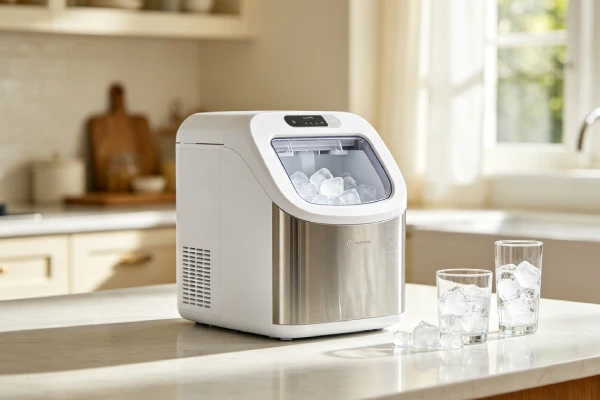
2. Large Condenser Coils
Why it matters: More surface area means better heat dissipation, which helps the compressor.
What to look for:
- Large visible coils
- Easy access for cleaning
Red flag: Sealed coils you can’t access or clean.
3. Removable Water Tank
Why it matters: Same as any unit — built-in tanks crack.
What to look for:
- Removable tank
- Replacement available
Red flag: Built-in tank.
4. Clear Maintenance Instructions
Why it matters: At altitude, maintenance is more important — the unit works harder.
What to look for:
- Clear descaling instructions
- Easy coil cleaning access
Red flag: No maintenance instructions.
💡 What Reviewers Miss (But You Need to Know)
| What Reviews Focus On | What Actually Matters at Altitude |
|---|---|
| “Makes ice fast!” | Will be 10–30% slower at altitude |
| “Great ice quality!” | Ice will be softer at altitude |
| “Quiet operation!” | Compressor works harder = more noise |
| “Easy to use!” | Maintenance is more important at altitude |
| “Perfect for any home!” | Doesn’t mention altitude performance |
70% of failures are dust, sensors, or filters — not the compressor. At altitude, these problems are worse because the unit works harder.
📅 Realistic Expectations: High Altitude
| Expectation | Reality |
|---|---|
| Ice production speed | 10–30% slower than sea level |
| Ice hardness | Softer — melts faster in drinks |
| Cycle time | Longer — unit works harder |
| Noise | Louder — compressor works harder |
| Maintenance | More important — unit works harder, needs more care |
| Lifespan | Slightly shorter — compressor works harder |
❓ FAQ: Ice Maker for High Altitude
Does high altitude affect ice makers?
Yes. Lower air pressure means lower boiling point AND lower freezing point. This makes the ice maker work harder and produce softer ice.
Why is my ice maker slower at high altitude?
The freezing point is lower, so the unit has to cool the water to a lower temperature to freeze it. This takes longer.
Why is my ice maker making soft ice at high altitude?
The water freezes at a lower temperature, so the ice forms slower and is less dense. This results in softer, “wetter” ice.
Can I fix my high-altitude ice maker?
You can’t change the physics, but you can help the unit: clean the coils, descale monthly, use distilled water, and provide good ventilation.
Should I buy a special ice maker for high altitude?
No. There is no “high altitude” ice maker. All countertop units work the same way — they just perform differently at altitude. Look for units with more powerful compressors and larger coils. Don’t pay extra for “high altitude” marketing.
Why is my high-altitude ice maker making grinding noise?
Grinding is NOT normal at any altitude. Turn it off immediately — the unit is frozen. Thaw it for 24 hours.
Why is my high-altitude ice maker not making any ice?
If the unit is not making any ice, it’s a mechanical issue — not altitude. Check the filter, coils, and water supply. If those are fine, the compressor may be failing.
Does distilled water help at high altitude?
Yes. Distilled water reduces scale buildup, which is especially important at altitude because the unit is already working harder.
How often should I descale at high altitude?
Monthly. The unit works harder at altitude, so scale builds up faster. Monthly descaling prevents the pump and evaporator from failing.
Is a more expensive ice maker better at altitude?
Not necessarily. Some expensive units have better compressors, but all units struggle at altitude. Look for features that help: large coils, easy cleaning access, and good ventilation. Don’t pay extra for “high altitude” marketing — it’s not real.
Can I use my ice maker at 10,000 feet?
Yes, but expect slower production and softer ice. Keep the unit clean, provide ventilation, and descale monthly. If it makes ice, it’s working.
🔑 The Bottom Line
| Your Problem | The Fix |
|---|---|
| Slow production at altitude? → | Clean coils ($0) → descale ($0–5) → use distilled water |
| Soft ice at altitude? → | Normal — expect softer ice (physics) |
| Ice melts fast? → | Normal — transfer to freezer promptly |
| Grinding noise? → | Turn off → Thaw 24 hours ($0) — NOT altitude-related |
| No ice at all? → | Check filter ($30) → check coils → check water supply |
| Unit over 5,000 ft? → | Expect 10–20% slower production (normal) |
| Unit over 8,000 ft? → | Expect 20–30% slower production (normal) |
| “High altitude” marketing? → | Ignore it — all units work the same way |
10. Technician Conclusion
Short Decisive Judgment: High altitude affects ice makers — lower boiling point and lower freezing point mean the unit has to work harder. Expect 10–30% slower production and softer ice. This is normal, not a defect. To help the unit, clean the coils, descale monthly, and use distilled water. If the unit is grinding or making no ice, it’s a mechanical issue — not altitude. Grinding is NEVER normal — turn it off immediately. At altitude, maintenance is more important because the unit works harder.
What Experienced Technicians Do: We always ask: “What altitude are you at?” If the client is above 5,000 feet, we set expectations: slower production, softer ice. We recommend cleaning coils and descaling more frequently. We never recommend a “special” unit — they don’t exist. We check for grinding and no-ice issues — those are mechanical, not altitude.
What Most Users Regret: They buy an ice maker, take it to their mountain cabin, and assume it’s broken because it’s slow. They return it or replace it — only to find the new one is the same. Or they pay extra for a “high altitude” unit that’s the same as any other. High altitude = slower production and softer ice. That’s physics, not a defect. There’s no “high altitude” ice maker. If the unit makes ice, it’s working. Clean it, maintain it, and adjust your expectations. Don’t pay extra for marketing claims.
📌 Quick Reference: Ice Maker High Altitude Guide
| Symptom | What It Means | Field Fix |
|---|---|---|
| Slower production | Normal — lower freezing point | Clean coils; descale monthly |
| Softer ice | Normal — lower freezing point | Transfer to freezer promptly |
| Ice melts in bin | Normal — unit is insulated, not refrigerated | Transfer to freezer |
| Grinding noise | NOT altitude — frozen unit | Turn off → Thaw 24 hours ($0) |
| No ice | NOT altitude — mechanical issue | Check filter, coils, water supply |
| Unit runs constantly | Normal — works harder at altitude | Check coils — if clean, it’s altitude |
| Unit over 5,000 ft | 10–20% slower | Normal — manage expectations |
| Unit over 8,000 ft | 20–30% slower | Normal — manage expectations |
| “High altitude” marketing | Not real — all units work the same | Don’t pay extra — ignore marketing |