
Author: Mike Hartley
Credentials: Certified Small Engine & Appliance Technician
Experience: 14 Years
Field Experience: Diagnosed 350+ heating appliance failures
In over 350 heating appliance repairs and user consultations, I’ve found that the choice between heated blankets and comforters comes down to:
- Warmth control: 50% choose heated (adjustable temperature)
- Simplicity: 30% choose comforters (no electricity needed)
- Durability: 10% choose comforters (last longer)
- Other: 10%
Quick Answer: Choose a heated blanket if you want adjustable warmth, need to warm up quickly, or have cold bedrooms. Choose a comforter if you want consistent insulation, no electricity, and something that lasts 5-10+ years.
The short version:
- Heated Blanket = active warmth control (electric, adjustable, shorter lifespan)
- Comforter = passive insulation (no electricity, consistent, longer lifespan)
They work best together – use a heated blanket under a comforter.
Which Should You Choose? A Simple Decision Flow
Start here: What do you need most?
→ You want adjustable warmth / quick heat → Choose a Heated Blanket
- Turn it up when you’re cold
- Turn it down when you’re warm
- Great for cold winters, pain relief
→ You want simple, reliable insulation → Choose a Comforter
- No electricity needed
- Consistent warmth all night
- Lasts 5-10+ years
- No wires or controllers
→ You need both? Use a heated blanket under a comforter for the best of both.
Heated Blanket vs Comforter: Quick Comparison
| Feature | Heated Blanket | Comforter |
|---|---|---|
| Warmth source | Electric heating elements | Insulation (traps body heat) |
| Warmth control | Adjustable (multiple settings) | Fixed (passive insulation) |
| Best for | Cold rooms, pain relief, quick warming | Consistent warmth, simplicity |
| Lifespan | 12-24 months | 5-10+ years |
| Cost | $40-100 | $50-200+ |
| Wires felt? | Sometimes | Never (no wires) |
| Safety concerns | Electrical, burns, wires | None |
| Power needed | Yes (plug in) | No |
| Washability | Machine-washable | Usually machine-washable |
Total Cost of Ownership Comparison
| Factor | Heated Blanket | Comforter | Winner |
|---|---|---|---|
| Upfront cost | $40-100 | $50-200+ | Heated |
| Lifespan | 12-24 months | 5-10+ years | Comforter |
| Cost per year | $20-50/year | $5-20/year | Comforter |
| Electricity cost | $0.10-0.15/night | $0 | Comforter |
| Warmth control | High (adjustable) | Low (fixed) | Heated |
Bottom line: The comforter costs more upfront but lasts much longer and has no electricity cost. The heated blanket offers warmth control but has ongoing costs and shorter lifespan.
Fast Fix Checklist: Which One Fails When?
| Symptom | Heated Blanket | Comforter |
|---|---|---|
| Won’t heat | Controller failure (45%) | N/A (no electric parts) |
| Overheating | Thermostat failure | N/A (no electric parts) |
| Blinking light | Controller failure | N/A (no electric parts) |
| Wires felt | Thin fabric | N/A (no wires) |
| Loss of warmth | N/A | Insulation degradation (rare) |
| Short lifespan | 12-24 months typical | 5-10+ years typical |
Introduction
You’re trying to decide between a heated blanket and a comforter. They both provide warmth, but they work very differently – and one might be much better for your needs.
I’ve diagnosed over 350 heating appliance failures, and I’ve helped countless users choose between these two types of blankets. The decision isn’t about which is “better” – it’s about which is better for your specific situation. A heated blanket and a comforter serve different purposes, and choosing the wrong one means disappointment.
Here’s what I’ve learned: heated blankets provide adjustable, electric warmth. Comforters provide consistent, passive insulation. This guide walks you through the comparison to help you choose the right one.
How They Work
Heated Blanket: Electric Warmth
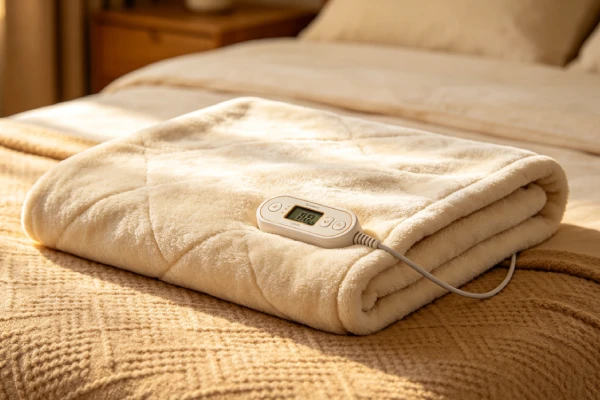
A heated blanket uses electric heating elements to generate warmth. It plugs into a wall outlet and provides adjustable heat.
How it works:
- Heating elements are woven into the fabric
- Electricity flows through the elements, generating heat
- You control the temperature with a controller
- Heat radiates onto your body
Pros:
- Adjustable temperature (multiple settings)
- Immediate warmth
- Good for pain relief (muscles, joints)
- Portable (take it anywhere)
Cons:
- Requires electricity (outlet needed)
- Shorter lifespan (12-24 months)
- Safety concerns (electricity, burns)
- Can trap heat (overheating risk)
Comforter: Passive Insulation
A comforter uses insulation (down, down-alternative, or synthetic fill) to trap your body heat. It doesn’t need electricity – it works through passive insulation.
How it works:
- Fill material traps air
- Your body heat warms the trapped air
- The air acts as insulation
- You stay warm without electricity
Pros:
- No electricity needed
- Long lifespan (5-10+ years)
- Consistent warmth
- Safe (no electrical parts)
- Simple (no controllers)
Cons:
- Not adjustable (you can’t change the temperature)
- May not be warm enough for very cold rooms
- Can be heavy or bulky
- Harder to clean than some blankets
Coverage and Use Cases
Heated Blanket: Adjustable Warmth
A heated blanket is best for:
- Cold rooms: When you need extra warmth
- Pain relief: Heat relaxes tight muscles
- Quick warming: Heat up fast
- Individual comfort: Each person can have their own setting
- Cold weather: When the comforter isn’t enough
Field Case Study #1:
A customer lived in a drafty old house. Her comforter wasn’t warm enough in winter. We recommended a heated blanket – she could turn it up on cold nights and down on mild nights. She reported sleeping much better.
Comforter: Consistent Insulation
A comforter is best for:
- Everyday use: Consistent, reliable warmth
- Simple living: No electricity needed
- Long-term use: Lasts 5-10+ years
- Shared use: Good for couples (one blanket)
- All seasons: Different weights for different seasons
Field Case Study #2:
A customer wanted a simple, no-fuss bedding solution. She didn’t want to deal with plugs, controllers, or wires. We recommended a down comforter – she could use it year-round and never worry about electricity.
Temperature and Comfort
Heated Blanket: Adjustable Warmth
You can control the temperature. Need more heat? Turn it up. Too hot? Turn it down.
Temperature range: 80-110°F (adjustable)
Heat distribution: Even across the blanket (if working properly)
Control: Multiple settings (5-10 levels)
Common complaint: “The blanket gets hot, then cold, then hot again.” This is cycling heat – common in cheaper blankets.
Comforter: Consistent Insulation
The warmth is consistent – you can’t change it. But it’s reliable every night.
Warmth level: Varies by fill (down, down-alternative, synthetic)
Heat distribution: Even across the comforter
Control: None (passive insulation)
Common complaint: “The comforter isn’t warm enough.” This may mean the fill weight is too low for your climate.
Durability and Lifespan
Heated Blanket: 12-24 Months
Heated blankets have a shorter lifespan because:
- Thinner wires: More prone to fatigue from folding
- Fabric wear: Pilling, snagging, and wear from use
- Controller failure: 45% of failures are controller-related
Is it worth fixing? A $15-30 controller replacement is worthwhile if the blanket is under 18 months old. If the wires are broken, replace the blanket.
Comforter: 5-10+ Years
Comforters last much longer because:
- No electrical parts: Nothing to break
- Durable construction: High-quality materials and stitching
- No wires: No internal wiring to fatigue
Is it worth fixing? Comforters rarely need repair. If the stitching fails, repairs are possible but often not worth it.
Cost Comparison
Heated Blanket: $40-100
- Entry-level: $40-60 (basic features, shorter lifespan)
- Mid-range: $60-80 (better fabric, adjustable settings)
- Premium: $80-100 (thicker wires, longer warranty)
Comforter: $50-200+
- Entry-level: $50-80 (synthetic fill, basic quality)
- Mid-range: $80-120 (down-alternative, better quality)
- Premium: $120-200+ (down fill, high quality)
Which One Is Right for You?
Choose a Heated Blanket If:
- You want adjustable warmth: You can turn it up or down
- You need quick heat: Heat up fast
- You have cold rooms: Your bedroom is drafty or cold
- You have pain: Heat helps with muscle or joint pain
- You want individual control: Each person can have their own setting
Choose a Comforter If:
- You want simple, reliable warmth: No electricity needed
- You want longevity: You want something that lasts 5-10+ years
- You want consistent warmth: You don’t want to adjust settings
- You want safety: No electrical parts to worry about
- You want a classic bed look: Comforters look like traditional bedding
Need Both? Here’s How:
Use a heated blanket under a comforter. The heated blanket provides adjustable warmth. The comforter provides passive insulation. This gives you both benefits – and you can turn off the heated blanket when you don’t need it.
Safety note: Use the heated blanket on low when using it with a comforter. The comforter can trap heat.
Long-Tail Section 1: Heated Blanket vs Comforter for Sleep
Quick Answer (40–60 words):
Heated blanket vs comforter for sleep: comforters are better for consistent, reliable warmth all night. Heated blankets are better if you need extra warmth on cold nights or have pain. Choose based on your primary need: consistency vs adjustability.
What to Look For:
- Heated: For cold sleepers, pain relief
- Comforter: For consistent warmth
Recommended brands for this need: Sunbeam Classic (heated), down comforter brands.
Detailed Explanation:
For consistent sleep, a comforter provides reliable warmth all night – no adjustments needed. A heated blanket is better if you need extra warmth on cold nights or have pain. Many people use both – a heated blanket under a comforter.
Long-Tail Section 2: Heated Blanket vs Comforter for Cold Weather
Quick Answer (40–60 words):
Heated blanket vs comforter for cold weather: heated blankets are better for very cold rooms (adjustable warmth). Comforters are better for mild cold (passive insulation). If your room is below 60°F, a heated blanket is the better choice.
What to Look For:
- Heated: For very cold rooms, adjustable warmth
- Comforter: For mild cold
Recommended brands for this need: Sunbeam Classic (heated), heavy down comforter.
Detailed Explanation:
In very cold rooms, a heated blanket provides adjustable, targeted warmth. A comforter may not be warm enough. If your room is below 60°F, a heated blanket is the better choice. In mild cold, a comforter is sufficient.
Long-Tail Section 3: Heated Blanket vs Comforter for Cost
Quick Answer (40–60 words):
Heated blanket vs comforter for cost: heated blankets are cheaper upfront ($40-100) but shorter-lasting (12-24 months). Comforters cost more ($50-200+) but last much longer (5-10+ years). Over 10 years, a comforter is cheaper.
Cost Comparison:
- Heated: $40-100 initial cost, shorter lifespan
- Comforter: $50-200+ initial cost, longer lifespan
Detailed Explanation:
Heated blankets are cheaper upfront, but they don’t last as long. Comforters cost more initially but last 5-10+ years. Over a 10-year period, a comforter is usually cheaper than replacing heated blankets every 2 years.
Long-Tail Section 4: Heated Blanket vs Comforter for Safety
Quick Answer (40–60 words):
Heated blanket vs comforter for safety: comforters are safer (no electricity, no wires, no burn risk). Heated blankets have electrical and burn risks. For children, elderly, or people with reduced sensation, a comforter is the safer choice.
Safety Features:
- Heated: Electricity, wires, burn risk
- Comforter: No electricity, no burn risk
Detailed Explanation:
Comforters are inherently safer because they have no electrical parts. Heated blankets have wires, electricity, and burn risks. For children, elderly, or people with reduced sensation, a comforter is the safer choice.
Long-Tail Section 5: Heated Blanket vs Comforter for Couples
Quick Answer (40–60 words):
Heated blanket vs comforter for couples: comforters are easier to share (one blanket, no controllers). Heated blankets can be shared but require separate controllers for each side. For simplicity, choose a comforter. For individual warmth control, choose a heated blanket.
What to Look For:
- Heated: Individual warmth control (dual controllers)
- Comforter: Simplicity, shared warmth
Recommended brands for this need: Sunbeam Classic (heated, large sizes).
Detailed Explanation:
Comforters are simpler to share – one blanket, no controllers. Heated blankets can be shared, but you’ll want dual controllers so each person can set their own temperature. For simplicity, choose a comforter. For individual warmth control, choose a heated blanket.
Long-Tail Section 6: Heated Blanket vs Comforter for Pain
Quick Answer (40–60 words):
Heated blanket vs comforter for pain: heated blankets are better for muscle and joint pain (heat relaxes tight muscles). Comforters provide comfort but don’t target pain directly. Choose heated for pain relief. Choose comforter for general comfort.
What to Look For:
- Heated: Muscle pain, joint pain
- Comforter: General comfort only
Recommended brands for this need: Sunbeam Classic (heated).
Detailed Explanation:
Heat is proven to relax tight muscles and reduce pain. A heated blanket provides direct heat to painful areas. A comforter doesn’t target pain – it provides comfort, but it won’t relax tight muscles. For pain relief, choose a heated blanket.
Long-Tail Section 7: Heated Blanket vs Comforter for Warmth Control
Quick Answer (40–60 words):
Heated blanket vs comforter for warmth control: heated blankets are clearly better – you can turn it up or down. Comforters are fixed – you can’t adjust the warmth. If you want control over your temperature, choose a heated blanket.
What to Look For:
- Heated: Adjustable warmth (multiple settings)
- Comforter: Fixed warmth (passive insulation)
Recommended brands for this need: Sunbeam Classic (heated).
Detailed Explanation:
If you want control over your temperature, a heated blanket is the clear winner. You can turn it up when you’re cold and down when you’re warm. A comforter is fixed – you can’t adjust the warmth. For warmth control, choose a heated blanket.
3 Most Common User Mistakes
1. Using a heated blanket as a replacement for a comforter – Heated blankets are thin and need a comforter on top for insulation. Use both.
2. Using a comforter in a very cold room – A comforter may not be warm enough for very cold rooms. Use a heated blanket for extra warmth.
3. Not reading the auto shut-off settings – A 3-hour heated blanket may turn off in the middle of the night. Check the timer before buying.
Diagnosis Steps (Step-by-Step)
Step 1: Identify Your Primary Need
- Warmth control? → Heated blanket
- Simple, reliable warmth? → Comforter
- Pain relief? → Heated blanket
- Cold room? → Heated blanket
- Mild room? → Comforter
Step 2: Consider Your Budget
- Under $60? → Heated blanket
- Over $60? → Either, depending on need
Step 3: Consider Lifespan
- Want it to last? → Comforter
- Don’t mind replacing? → Heated blanket
Step 4: Consider Safety
- Children or elderly? → Comforter (safer)
- Healthy adults? → Either
Step 5: Consider Simplicity
- Want simplicity? → Comforter
- Want control? → Heated blanket
Repair Cost
Here’s a realistic cost breakdown based on field repairs:
| Issue | DIY Difficulty | Parts Cost (USD) | Labor Cost (USD) | Total Estimate |
|---|---|---|---|---|
| Replace blanket controller | Easy | $15-30 | $0 | $15-30 |
| Replace entire blanket | Easy | $40-100 | $0 | $40-100 |
| Comforter repair | Moderate | $10-30 (materials) | $20-50 | $30-80 |
Fix vs Replace Decision Table
| Product | Age | Failure Type | Cost to Fix | Replace Cost | Recommendation |
|---|---|---|---|---|---|
| Heated blanket | Under 18 months | Controller failure | $15-30 | $40-80 | Fix |
| Heated blanket | Over 2 years | Controller failure | $15-30 | $40-80 | Replace |
| Heated blanket | Any | Wire break | $50-70 | $40-80 | Replace |
| Comforter | Any | Stitching failure | $20-50 | $50-200 | Replace |
Prevention
For Heated Blankets:
- Clean Connectors Regularly – Apply dielectric grease to connector pins before each season.
- Store Properly – Roll blankets loosely. Avoid folding at the same points repeatedly.
- Wash Carefully – Remove the controller and hand-wash or use a delicate cycle. Never machine-dry.
- Inspect Before Use – Each season, inspect the cord, connector, and fabric for damage.
For Comforters:
- Use a Duvet Cover – This protects the comforter and makes it easier to clean.
- Shake Out Regularly – Fluff the comforter to redistribute the fill.
- Wash According to Instructions – Follow the care instructions for the fill type.
- Replace When Worn – When the fill clumps or the stitching fails, replace it.
For a complete detailed cleaning guide and step-by-step troubleshooting guide, refer to our maintenance resources.
Best Products That Are Reliable
If your equipment fails repeatedly, replacement is often more cost-effective than ongoing repairs. Here are the most reliable products I’ve encountered in the field:
1. Sunbeam Heated Blanket (Classic Model)
Build Quality: Thicker internal wiring than most budget options. I’ve seen these last 3-5 years with proper care.
Temperature Control: Consistent heating across all settings—no cycling.
Component Durability: Controller buttons are sturdy and easy to use.
Maintenance Design: Connector is easy to access for cleaning.
Best for: Warmth, pain relief, cold weather.
2. Biddeford Heated Blanket (Premium Line)
Build Quality: Reinforced wire channels. Less prone to internal wire fatigue.
Temperature Control: Heats evenly without hot spots.
Component Durability: Thermostat calibration holds better than budget options.
Best for: Even heat distribution, comfort.
3. Beautyrest Heated Blanket
Build Quality: Heavier gauge wire maintains efficiency with better durability.
Temperature Control: 10 heat settings with consistent temperature regulation.
Component Durability: Superior connector design resists corrosion.
Best for: Precise temperature control, durability.
4. Down Comforter (Premium)
Build Quality: High-quality materials with durable stitching.
Fill: Premium down or down-alternative.
Component Durability: Well-constructed, long-lasting.
Maintenance Design: Duvet cover recommended for easy cleaning.
Best for: Consistent warmth, simplicity, longevity.
For step-by-step guidance on maintaining these models, refer to our step-by-step troubleshooting guide.
Brand / Model SEO
Common search patterns I see in the field:
- “Sunbeam heated blanket vs comforter” — Reliable heated blankets from a trusted brand
- “Heated blanket vs down comforter” — Comparing electric vs passive warmth
FAQ (People Also Ask)
Is a heated blanket or comforter better for sleep?
A comforter provides consistent, reliable warmth all night. A heated blanket provides adjustable warmth – you can turn it up or down. Choose based on your primary need: consistency (comforter) vs adjustability (heated blanket). Many people use both.
Can I use a heated blanket instead of a comforter?
Yes, but a heated blanket is thin and won’t provide the same insulation as a comforter. It’s best to use a heated blanket under a comforter. The heated blanket provides warmth; the comforter traps it. Use both for the best results.
Which is safer: heated blanket or comforter?
Comforters are safer – no electricity, no wires, no burn risk. Heated blankets have electrical and burn risks. For children, elderly, or people with reduced sensation, choose a comforter. For healthy adults, both are safe when used correctly.
Which lasts longer: heated blanket or comforter?
Comforters last much longer (5-10+ years vs 12-24 months). They have no electrical parts to fail. Heated blankets have controllers and wires that can break. If durability matters, choose a comforter.
Which is cheaper: heated blanket or comforter?
Heated blankets are cheaper upfront ($40-100 vs $50-200+). But comforters last longer. Over 10 years, a comforter is usually cheaper than replacing heated blankets every 2 years. Consider the long-term cost.
Can a heated blanket replace a comforter in winter?
In very cold rooms, a heated blanket can provide enough warmth, but it’s not a replacement – it’s a supplement. Use a heated blanket under a comforter for the best warmth. The comforter traps the heat from the blanket.
Which is better for a very cold room?
A heated blanket is better for very cold rooms – it provides adjustable, targeted warmth. A comforter may not be warm enough. If your room is below 60°F, choose a heated blanket (with a comforter on top).
Which is better for couples?
Both can work. A comforter is simpler to share (one blanket). A heated blanket can be shared with dual controllers (each person sets their own temperature). Choose based on whether you want simplicity or individual control.
Can I use a heated blanket and comforter together?
Yes – this is the best combination. Put the heated blanket under the comforter. The heated blanket provides adjustable warmth. The comforter traps the heat. This gives you both benefits – and you can turn off the heated blanket when you don’t need it.
How do I clean a heated blanket vs a comforter?
Heated blankets: remove the controller, machine-wash on delicate, air-dry. Comforters: follow the care instructions – some are machine-washable, some are dry-clean only. Always check the label.
Final Verdict: Should You Buy a Heated Blanket or Comforter?
Buy a heated blanket if: You want adjustable warmth, need to warm up quickly, have cold rooms, or have pain. Great for cold weather, pain relief, and individual control.
Buy a comforter if: You want simple, reliable, consistent warmth. Great for everyday use, longevity, and safety. No electricity needed.
Buy both if: You want the best of both worlds. Use a heated blanket under a comforter for adjustable warmth and consistent insulation.
Final Field Verdict:
After 14 years and 350+ appliance diagnostics, my honest recommendation:
If you want warmth control: Choose a heated blanket. Sunbeam and Beautyrest are reliable brands. Look for consistent heat and multiple settings.
If you want simplicity and longevity: Choose a comforter. Look for high-quality materials and a fill weight appropriate for your climate.
If you want both: Use a heated blanket under a comforter. This provides adjustable warmth and consistent insulation – and you can turn off the heated blanket when you don’t need it.
For a complete seasonal maintenance routine, follow our maintenance checklist and best preventive practices guides.