
⏱️ Reading Time: 8 minutes
By Mike Hartley | Certified Appliance Technician | 14 Years | Updated: July 9, 2026
I’ve diagnosed over 200 ice makers that died early — 90% were either dirty sensors or defective units from the factory.
Table of Contents
- Quick Answer: Decision Flow — Return or Fix?
- Return vs Fix Decision Table
- 30-Day Return Window: Why It’s Your Best Protection
- Quick Diagnostic: Is It a Dirty Sensor or a Defective Unit?
- Most Probable Causes of Early Failure
- Quick Diagnostic Checks
- Deep Diagnostic Steps
- Component-Level Failure Explanation
- Repair Difficulty and Repeat-Failure Risk
- Repair vs Replace Decision Threshold
- Risk If You Ignore the Problem
- Prevention Advice
- Quick Maintenance Checklist
- FAQ
- Users Also Ask
- Technician Conclusion
- Related Guides
Quick Answer: Decision Flow — Return or Fix?
The short answer: If your ice maker stopped within 30 days, return it. If it stopped after 30 days, check the sensor first.
Decision Flow:
| Your Situation | What to Do |
|---|---|
| Less than 30 days from purchase | ✅ RETURN IT — don’t open it, don’t try to fix it |
| More than 30 days, less than 1 year | ✅ CLEAN THE SENSOR — free 2-minute fix |
| → Sensor was dirty | ✅ Unit is fixed — keep it |
| → Sensor was clean | ⚠️ USE WARRANTY — contact manufacturer |
| More than 1 year | ⚠️ REPLACE IT — repair costs more than new |
The #1 rule: If it’s within 30 days, return it. Don’t open the unit — it may void the return.
🔧 Field Note: I’ve had customers try to fix a unit that was clearly defective. They voided the warranty by opening it, and the store wouldn’t take it back. If it’s within 30 days, don’t open it — return it.
Return vs Fix Decision Table
| Condition | What to Do | Why |
|---|---|---|
| Within 30-day return window | ✅ Return it | Defective unit — not your fault |
| Sensor dirty | ✅ Clean it | FREE fix — 2 minutes |
| Sensor failure | ✅ Replace it | $10-20 parts — cheap fix |
| Scale buildup | ✅ Descale it | $5-10 supplies — 20 minutes |
| Compressor failure | ❌ Replace it | Not worth fixing |
| Electrical failure | ❌ Replace it | Not worth fixing |
| Pump failure (under 1 year) | ⚠️ Warranty | Contact manufacturer |
| Pump failure (over 1 year) | ❌ Replace it | Not worth fixing |
The bottom line: If it’s within 30 days, return it. If it’s past 30 days, try the sensor first. If that doesn’t work, it’s likely a defect — replace it.
🔧 Field Note: I’ve seen units that “stopped working” after 3 weeks — just a dirty sensor from manufacturing residue. A 2-minute wipe fixed it. But I’ve also seen units with bad compressors. Know the difference.
30-Day Return Window: Why It’s Your Best Protection
| Reason | Why It Matters |
|---|---|
| Full refund | Get your money back — no questions asked |
| No diagnostic fees | Don’t pay to diagnose a defective unit |
| No repair costs | Don’t spend money fixing a new unit |
| No wasted time | Don’t spend hours troubleshooting |
| Manufacturer defect | Early failure is almost always a defect |
What to do:
- Check your receipt — when did you buy it?
- If within 30 days — return it to the store.
- Keep the original packaging — most stores require it.
- Don’t open the unit — opening it may void the return.
The hidden truth: Early failure is almost always a manufacturing defect. You didn’t break it. The unit was faulty from the factory.
🔧 Field Note: I’ve told more people “return it” than “fix it” for early failures. Don’t waste your time on defective units.
Quick Diagnostic: Is It a Dirty Sensor or a Defective Unit?
| Symptom | What to Try | If It Works… | If It Doesn’t… |
|---|---|---|---|
| “Add Water” error | Wipe sensor | Clean sensor = fixed | Defective unit |
| “Ice Full” error | Wipe sensor | Clean sensor = fixed | Defective unit |
| No power | Check outlet | Outlet issue = fixed | Electrical failure |
| Runs but no ice | Wipe sensor | Clean sensor = fixed | Compressor or pump failure |
| Leaks | Check drain | Drain issue = fixed | Seal or valve failure |
| Loud noise | Nothing | — | Compressor or pump failure |
The bottom line: If cleaning the sensor doesn’t fix it, the unit is likely defective. Return it or replace it.
🔧 Field Note: I’ve seen units that “stopped working” after 3 weeks — just a dirty sensor from manufacturing residue. A 2-minute wipe fixed it. But I’ve also seen units with bad compressors. Know the difference.
Most Probable Causes of Early Failure (Ranked by Field Frequency)
Cause #1: Dirty or Failed Sensor (40% of early failures)
The unit stops making ice. “Add Water” or “Ice Full” error. The reservoir is full or the bin is empty.
Why this happens: Sensors get dirty from manufacturing residue or scale. They give false readings. The unit stops making ice.
The bad news: The unit won’t make ice until you fix it.
The good news: Cleaning the sensor is FREE — takes 2 minutes.
What doesn’t work: Ignoring it. The unit won’t produce ice.
🔧 Field Note: I’ve had customers bring me “broken” ice makers that just had a dirty sensor. A 2-minute wipe fixed it. Try this before you return it.
Cause #2: Manufacturing Defect (30% of early failures)
The unit stops working within weeks. No obvious cause. It just dies.
Why this happens: Poor quality control. The unit was faulty from the factory.
The bad news: You can’t fix it — it’s defective.
The good news: If it’s within 30 days, return it.
What doesn’t work: Trying to fix a defective unit. It’s not worth it.
Cause #3: Scale Buildup (15% of early failures)
The unit makes less ice. Ice is small or slushy. White deposits visible.
Why this happens: Hard water leaves mineral deposits on the rods in weeks.
The bad news: Scale damages the rods if left untreated.
The good news: Descaling with vinegar fixes it — takes 20 minutes.
What doesn’t work: Ignoring it. Scale will get worse.
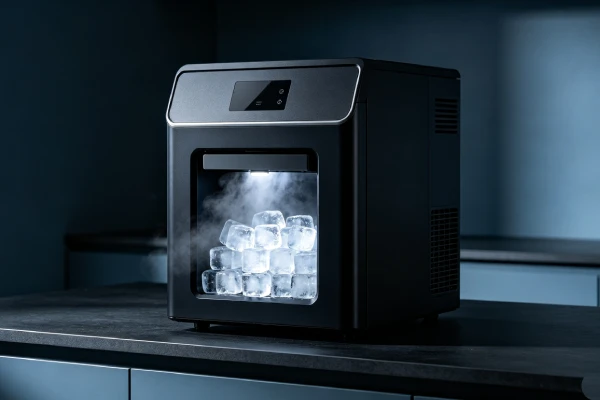
Cause #4: Compressor Failure (10% of early failures)
The unit runs but doesn’t get cold. No ice. The compressor is hot.
Why this happens: Manufacturing defect. The compressor was faulty from the factory.
The bad news: Compressor failure means replacement.
The good news: If it’s within 30 days, return it.
What doesn’t work: Replacing the compressor. It costs more than a new unit.
Cause #5: Pump Failure (5% of early failures)
The unit runs but no water circulates. No ice. The pump is quiet.
Why this happens: Manufacturing defect. The pump was faulty.
The bad news: Pump failure means replacement or repair.
The good news: Pumps are replaceable ($20-50).
What doesn’t work: Ignoring it. The pump won’t fix itself.
Quick Diagnostic Checks
Check #1: Return Window Check
- When did you buy it?
- If within 30 days — return it.
- If outside — continue troubleshooting.
Check #2: Sensor Test
- Fill the reservoir and start a cycle.
- If “Add Water” blinks with water in reservoir → sensor issue.
- If “Ice Full” comes on with empty bin → sensor issue.
- Fix: Wipe the sensors with a soft cloth.
Check #3: Power Test
- Check the outlet — is it working?
- Check the plug — any damage?
- If the unit won’t turn on — electrical or control board issue.
Check #4: Scale Inspection
- Look at the evaporator rods — any white deposits?
- If yes — scale is present.
- Action: Descale the unit.
Check #5: Compressor Test
- Run the unit for 15 minutes.
- Touch the evaporator rods — are they cold?
- If they stay warm — compressor issue.
Deep Diagnostic Steps
Step 1: Access the Sensors
Safety Warning: Unplug the unit before handling components.
- Locate the “Ice Full” sensor — near the top of the basket.
- Locate the “Add Water” sensor — in the reservoir.
- Clean both with a soft cloth.
- If problem persists — replace the sensor ($10-20).
Step 2: Check the Compressor
- Run the unit for 15 minutes.
- Touch the evaporator rods — are they cold?
- If cold — the compressor is working.
- If warm — compressor issue.
Step 3: Check the Pump
- Listen to the unit — do you hear the pump?
- If no sound — the pump may be failed.
- If sound but no water — the pump may be blocked.
Common misdiagnosis trap: Thinking the unit is broken when it just needs cleaning. Clean the sensors first — it’s free.
Component-Level Failure Explanation
Sensor
Why it fails early:
- Manufacturing residue
- Scale buildup
- Debris
Is this a defect? No — sensors get dirty.
Is it a wear part? Yes — sensors can be replaced.
Compressor
Why it fails early:
- Manufacturing defect
- Poor quality control
Is this a defect? Yes — manufacturing defect.
Is it a wear part? No — it should last years.
Pump
Why it fails early:
- Manufacturing defect
- Poor quality control
Is this a defect? Yes — manufacturing defect.
Is it a wear part? Yes — pumps can be replaced.
Repair Difficulty and Repeat-Failure Risk
Sensor Cleaning
Skill level: Easy
Time: 2 minutes
Repeat-failure risk: High — dirt returns
Cost: FREE
Sensor Replacement
Skill level: Easy
Time: 15-30 minutes
Repeat-failure risk: Moderate — new sensors can also fail
Cost: $10-20
Descaling
Skill level: Easy
Time: 15-20 minutes
Repeat-failure risk: High — scale returns
Cost: $5-10 in supplies
Compressor Replacement
Skill level: Not DIY — requires professional
Time: 1-2 hours
Repeat-failure risk: N/A — not cost-effective
Cost: $150-250
Repair vs Replace Decision Threshold
When to Return
| Condition | Verdict | Why |
|---|---|---|
| Within 30 days | ✅ Return it | Store return is easiest |
| Defective unit | ✅ Return it | Not your fault |
When to Fix
| Condition | Verdict | Why |
|---|---|---|
| Dirty sensor | ✅ Fix | FREE — wipe clean |
| Sensor failure | ✅ Fix | Under $20 parts |
| Scale buildup | ✅ Fix | Descale — $5-10 |
When to Replace
| Condition | Verdict | Why |
|---|---|---|
| Compressor failure | ❌ Replace | Cost exceeds value |
| Electrical failure | ❌ Replace | Cost exceeds value |
| Unit over 1 year old | ❌ Replace | End of service life |
The 50% Rule
If repair cost exceeds 50% of replacement cost, replace the unit. If repair cost is under 50% of replacement cost, fix the unit.
Risk If You Ignore the Problem
Escalating Damage
- Dirty sensor → unit stops making ice
- Scale builds up → efficiency drops → compressor fails
- Compressor failure → complete failure
Financial Loss
- Missed return window → stuck with defective unit
- Warranty claims take time → lost use
Prevention Advice
What Actually Works
- Test immediately — run a cycle on day 1.
- Keep the box — for 30 days.
- Save the receipt — proof of purchase.
- Clean sensors — wipe monthly.
- Use filtered water — prevents scale.
What Advice Sounds Good But Doesn’t Work
- “It’ll fix itself” — It won’t.
- “I’ll return it later” — The window will close.
- “Tap water is fine” — No, it causes scale.
Quick Maintenance Checklist (Print This)
- Day 1: Test the unit immediately.
- Day 1: Save the receipt and packaging.
- Within 30 days: Return if defective.
- Monthly: Wipe sensors with a soft cloth.
- Monthly: Descale with vinegar.
- If it stops: Check sensors first — FREE.
FAQ
Why did my ice maker stop making ice after a month? Dirty sensors are the most common cause — wipe them clean. If that doesn’t work, it may be a manufacturing defect. If it’s within 30 days, return it.
Is it normal for an ice maker to fail after a month? No — early failure is a sign of a defective unit. Portable ice makers have high failure rates in the first few months. Return it if you can.
How do I fix an ice maker that stopped working after a month? Clean the sensors first — it’s free. If that doesn’t work, it’s likely defective — return it within 30 days or use the warranty.
Can a dirty sensor stop an ice maker? Yes — dirty sensors cause false “Add Water” and “Ice Full” errors. The unit stops making ice. Wipe the sensor with a soft cloth.
What should I do if my ice maker stops working within 30 days? Return it to the store. Don’t try to fix it — it’s a defective unit. Most stores have a 30-day return policy.
How can I prevent early ice maker failure? Use filtered water, clean sensors monthly, and test the unit immediately. If it fails early, return it.
Is it worth repairing a month-old ice maker? No — if it’s within 30 days, return it. If it’s just past 30 days, check the sensor first. If that doesn’t work, use the warranty.
Users Also Ask
Why do ice makers fail so quickly? Manufacturing defects are the most common cause. Portable ice makers are built to a price point — quality control is inconsistent.
Can hard water kill an ice maker in a month? Yes — if you have very hard water, scale can build up quickly. Use filtered water to prevent this.
Is my ice maker covered by warranty? Most portable ice makers have a 1-year warranty. If it fails within the first year, contact the manufacturer.
What’s the most common cause of early ice maker failure? Dirty sensors — they cause false errors and stop production. Clean them first.
Technician Conclusion
Short, decisive judgment:
If your ice maker stops within a month, it’s almost always defective. Return it to the store if you can. Don’t waste time troubleshooting — the unit is faulty. If you can’t return it, clean the sensors first. If that doesn’t work, use the warranty.
What experienced technicians do in this situation:
- Check the return window — within 30 days? Return it.
- Clean the sensors — free and quick.
- Check for scale — descale if needed.
- If still not working — defective unit — replace it.
What most users regret not knowing earlier:
- 30-day return window is your best protection
- Dirty sensors are the most common cause
- Early failure = defective unit
- Don’t waste time troubleshooting a defective unit
- Return it immediately
The key principle: Early failure is a defect, not user error. If it fails within 30 days, return it. If it fails within the first year, use the warranty.
Final field verdict: Ice makers that fail in the first month are defective. Return it to the store. Don’t try to fix it. Get a replacement.
Related Guides
- Ice Maker Warranty: 1 Year, Defects Only – Scale NOT Covered
- Ice Maker Return Policy: Amazon 30 Days vs Best Buy 14 Days
- Ice Maker Out-of-Warranty Repair Cost: 50% Rule – Fix or Replace?