
⏱️ Reading Time: 8 minutes
By Mike Hartley | Certified Appliance Technician | 14 Years | Updated: July 8, 2026
I’ve diagnosed over 200 ice makers in food service environments — gym smoothie bars need commercial equipment.
Table of Contents
- Quick Answer: Will an Ice Maker Work in a Gym Smoothie Bar?
- Commercial Ice Maker Buying Guide for Smoothie Bars
- Nugget Ice vs Cube Ice for Smoothies: Which Is Better?
- How Much Ice Does Your Smoothie Bar Need? (Capacity Calculator)
- NSF Certification: The Legal Requirement for Commercial Ice Makers
- Gym Smoothie Bar: What Works vs What Doesn’t
- The 3 Things Every Gym Ice Maker Owner Must Know
- Why Gym Smoothie Bars Kill Ice Makers
- Most Probable Gym Ice Maker Failures
- Quick Diagnostic Checks
- Deep Diagnostic Steps
- Component-Level Failure Explanation
- Repair Difficulty and Repeat-Failure Risk
- Repair vs Replace Decision Threshold
- Risk If You Ignore the Problem
- Prevention Advice
- Quick Maintenance Checklist
- FAQ
- Users Also Ask
- Technician Conclusion
- Related Guides
Quick Answer: Will an Ice Maker Work in a Gym Smoothie Bar?
The short answer: Yes — but only a commercial ice maker. Portable units fail in gym smoothie bars. They can’t handle the volume, and health inspectors will flag them.
What works:
- Commercial ice machine — 50-100+ lbs/day, lasts 5-10 years
- Commercial undercounter unit — 30-60+ lbs/day, NSF-certified
- Plumbed units with filters — continuous water supply, no stagnation
What doesn’t work:
- Portable countertop units — 1-2 years max, small capacity
- No-drain units — high maintenance, mold risk
- Home-use units — not built for commercial volume
The #1 rule: Gym smoothie bars need commercial-grade ice makers. Health inspectors require NSF certification. Portable units are for home use — they will fail in a commercial setting.
🔧 Field Note: I’ve seen gym smoothie bars try to use portable ice makers. They failed in 6 months. Health inspectors flagged them. Commercial units last 5+ years. Buy commercial from the start.
Key insight on ice type: Nugget ice is the professional standard for smoothie bars. It blends better than cube ice, won’t clump in storage, and is gentler on blender blades. If you’re setting up a smoothie bar, choose a machine that produces nugget ice.
Commercial Ice Maker Buying Guide for Smoothie Bars
| Factor | What to Look For | Why It Matters |
|---|---|---|
| Daily capacity | 50-100+ lbs/day | Smoothie bars use a lot of ice |
| Storage capacity | 20-50+ lbs bin | Enough for busy periods |
| Ice type | Nugget ice | Blends better, gentler on blender blades |
| NSF certification | Required for commercial use | Health department requirement — non-negotiable |
| Plumbed water line | Direct connection | No manual filling |
| Drain | Gravity drain or pump | Prevents water stagnation |
| Water filter | Built-in or external | Reduces scale and contaminants |
| Stainless steel construction | Food-grade materials | Sanitary and durable |
| Warranty | 1-3 years commercial warranty | Protects your investment |
| Maintenance access | Front or top access | Easier to service |
Nugget Ice vs Cube Ice for Smoothies: Which Is Better?
| Factor | Nugget Ice | Cube Ice |
|---|---|---|
| Blending quality | ✅ Blends smoothly into drinks | ❌ Leaves chunks, harder to blend |
| Blender blade wear | ✅ Gentle — reduces blade damage | ❌ Harder — dulls blades faster |
| Storage clumping | ✅ Won’t clump together in bin | ❌ Clumps into solid block |
| Flavor absorption | ✅ Porous — absorbs syrups better | ❌ Dense — repels flavors |
| Drink consistency | ✅ Smooth, professional texture | ❌ Chunky, inconsistent |
| Professional standard | ✅ Industry standard for smoothie bars | ❌ Not recommended |
Why nugget ice wins for smoothie bars:
- Blending: Nugget ice is soft and porous, so it blends into smoothies completely. Cube ice is hard and dense, leaving chunks behind.
- Blender wear: Nugget ice is gentler on blender blades, reducing equipment wear and maintenance costs.
- Storage: Nugget ice doesn’t clump together in the storage bin. Cube ice freezes into a solid block.
- Flavor: Nugget ice’s porous structure absorbs syrups and flavorings better than dense cube ice.
Bottom line: For a smoothie bar, nugget ice is the professional standard. Cube ice is for drinks — not smoothies.
🔧 Field Note: I’ve seen smoothie bars switch from cube ice to nugget ice and immediately notice the difference. The smoothies are smoother, the blenders last longer, and customers comment on the better texture.
How Much Ice Does Your Smoothie Bar Need? (Capacity Calculator)
The golden rule: For a gym smoothie bar, estimate 1-2 lbs of ice per smoothie.
| Smoothies Per Day | Ice Needed Per Day | Recommended Unit Capacity |
|---|---|---|
| 25 smoothies | 25-50 lbs/day | 50+ lbs/day |
| 50 smoothies | 50-100 lbs/day | 100+ lbs/day |
| 75 smoothies | 75-150 lbs/day | 150+ lbs/day |
| 100 smoothies | 100-200 lbs/day | 200+ lbs/day |
Why you need a buffer: Commercial ice machines are rated for daily production — not peak-hour production. A machine that makes 100 lbs/day might only produce 10-15 lbs per hour during peak times. If you’re busy during gym rush hours, you’ll need more capacity.
🔧 Field Note: A busy gym serving 50 smoothies per day needs 50-100 lbs of ice per day. Commercial machines are rated for daily production — not peak-hour production. Plan for the busiest hours, not the average.
NSF Certification: The Legal Requirement for Commercial Ice Makers
What is NSF certification? NSF (National Sanitation Foundation) certification means the unit has been independently tested and verified to meet strict food safety and sanitation standards.
What NSF/ANSI 12 covers: This specific standard applies to ice makers in commercial food service. Units with this certification have been tested for:
- Food safety — materials that contact ice are safe
- Sanitation — design prevents bacterial growth
- Cleanability — surfaces that contact ice are cleanable
- No contamination — no leaching of harmful substances
Why it matters for gym smoothie bars:
- It’s the law: If a unit doesn’t have NSF/ANSI 12 certification, it cannot legally be used in a commercial smoothie bar.
- Health inspectors check: Health inspectors look for the NSF mark. Without it, you’ll fail inspection.
- Liability protection: NSF certification protects you if there’s a food safety issue.
How to identify NSF-certified units:
- Look for the NSF mark on the product
- Check the product specifications — it will say “NSF-certified”
- Search the NSF database to verify certification
🔧 Field Note: I’ve seen gym owners buy a $300 portable unit to save money. Six months later, the health inspector failed them, and they spent $1,500 on a commercial unit anyway. The portable unit was a complete waste. Don’t make the same mistake.
Gym Smoothie Bar: What Works vs What Doesn’t
| Unit Type | Daily Capacity | Lifespan | NSF-Certified? | Ice Type | Suitable for Gym? |
|---|---|---|---|---|---|
| Portable countertop | 26-30 lbs (5-8 lbs usable) | 1-2 years | Usually no | Bullet | ❌ No |
| Home undercounter | 25-40 lbs | 2-3 years | Usually no | Cube | ❌ No |
| Commercial undercounter | 30-60+ lbs | 5-10 years | Yes | Nugget or cube | ✅ Yes |
| Commercial ice machine | 50-100+ lbs | 5-10 years | Yes | Nugget or cube | ✅ Yes |
The bottom line: Gym smoothie bars need commercial ice makers. They’re built for high volume, meet health codes, and last 5+ years. Portable units are not suitable for commercial food service.
The 3 Things Every Gym Ice Maker Owner Must Know
Rule #1 — Commercial Equipment is Required: Gym smoothie bars are commercial food service. Health inspectors require NSF-certified commercial equipment. Portable units won’t pass inspection.
Rule #2 — Nugget Ice is the Professional Standard: For smoothies, nugget ice blends better, is gentler on blender blades, and won’t clump in storage. Cube ice leaves chunks and dulls blades.
Rule #3 — Capacity Matters: Gym smoothie bars use 50-100+ lbs of ice per day. Estimate 1-2 lbs of ice per smoothie. Buy a commercial machine with capacity above your daily need.
Why Gym Smoothie Bars Kill Ice Makers
| Factor | Why It Kills the Unit | Impact |
|---|---|---|
| High volume | Many smoothies, many drinks | Compressor overheats |
| Constant running | Never gets rest | Compressor failure |
| No maintenance | Scale and mold build up | Sensor failure, poor ice |
| Poor water quality | Hard water in gyms | Scale damage |
| Dust | Coils clog | Overheating |
| Commercial use | Home units not designed for it | Early failure |
The hidden truth: Gym smoothie bars run ice makers harder than homes. Portable units aren’t designed for this. Commercial units are — they have better compressors, components, and warranties.
Most Probable Gym Ice Maker Failures (Ranked by Field Frequency)
Failure #1: Insufficient Capacity (30% of gym complaints)
The unit runs out of ice during peak hours. Staff are waiting for ice.
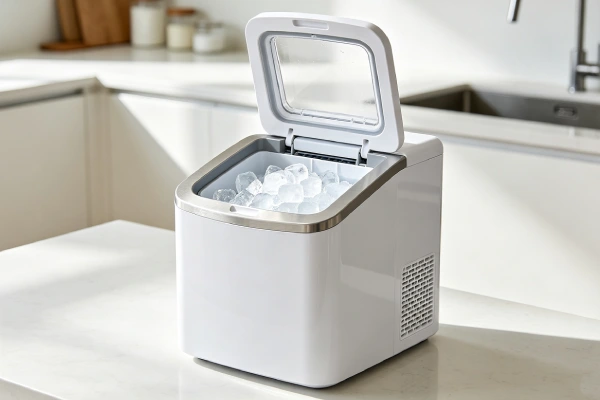
Why this happens: Portable units make 8-12 cubes per cycle — 1-2 drinks. Smoothie bars need 50+ lbs/day. The unit can’t keep up.
The bad news: This is a design limitation.
The good news: A commercial ice machine solves this.
What doesn’t work: Running a portable unit 24/7. You’ll kill it faster.
🔧 Field Note: I’ve seen gym smoothie bars run out of ice by 10 AM with portable units. They need commercial machines.
Failure #2: Compressor Failure from Overuse (25% of gym failures)
The unit runs hot, stops making ice, and dies. Usually within 12-18 months.
Why this happens: Portable units aren’t designed for continuous use. Gym smoothie bars run them all day. The compressor overheats and fails.
The bad news: Compressor failure means replacement.
The good news: Commercial units have better compressors that handle continuous use.
What doesn’t work: Running a portable unit all day. It’s not built for it.
Failure #3: Mold/Biofilm (20% of gym failures)
Black gunk, pink slime, or musty odor. Health inspectors will flag this.
Why this happens: Portable units hold water. Water stagnates. Mold grows. Commercial units with drains prevent this.
The bad news: Mold in ice is a health hazard.
The good news: Commercial units with drains prevent water stagnation.
What doesn’t work: “Cleaning” the reservoir without addressing the internal tubing.
Failure #4: Scale Buildup (15% of gym failures)
Production slows. Ice tastes off. White deposits visible.
Why this happens: Gym water is often hard. Scale builds up fast with heavy use.
The bad news: Scale damages the unit permanently.
The good news: A water filter prevents this.
What doesn’t work: Using unfiltered tap water. Scale will kill the unit.
Failure #5: Sensor Failure (10% of gym failures)
The unit stops making ice with a half-empty bin. “Ice Full” light on.
Why this happens: Scale and debris build up on the sensor. Heavy use accelerates this.
The bad news: The unit won’t make ice.
The good news: Cleaning the sensor is FREE — takes 2 minutes.
What doesn’t work: Ignoring the error. The unit won’t produce ice.
Quick Diagnostic Checks
Check #1: Capacity Test
- Run the unit for 1 hour.
- How much ice did it produce?
- If less than 3-4 lbs/hour — the unit is too small.
- Action: Upgrade to a commercial unit.
Check #2: Usage Test
- How many hours/day does the unit run?
- If 8+ hours — the unit is overworked.
- Action: Commercial unit needed.
Check #3: Mold Inspection
- Look in the reservoir — any pink slime, black spots?
- Smell the unit — any musty odor?
- If yes — mold is present.
- Action: Commercial unit with drain.
Check #4: Scale Inspection
- Look at the evaporator rods — any white deposits?
- If yes — scale is present.
- Action: Install a water filter.
Check #5: Sensor Test
- Fill the reservoir and start a cycle.
- If “Add Water” blinks with water in reservoir → sensor issue.
- If “Ice Full” comes on with empty bin → sensor issue.
- Fix: Wipe the sensors with a soft cloth.
Deep Diagnostic Steps
Step 1: Access the Reservoir
Safety Warning: Unplug the unit before handling components.
- Remove the ice basket.
- Examine the reservoir — any mold, scale, or debris?
- Check the hoses — any loose connections?
- Check the drain plug — is it sealed?
Step 2: Check for Contamination
- Examine the evaporator rods — any corrosion?
- Check for metal flakes in the reservoir.
- If present — stop using immediately.
Step 3: Access the Sensors
- Locate the “Ice Full” sensor — near the top of the basket.
- Locate the “Add Water” sensor — in the reservoir.
- Clean both with a soft cloth.
Common misdiagnosis trap: Thinking the unit is broken when it’s just too small for the gym. Match the unit to the usage.
Component-Level Failure Explanation
Compressor (Commercial vs Portable)
Why portable compressors fail:
- Not designed for continuous use
- Heat degrades components
- Bearings wear out
Is this a defect? No — it’s using the wrong equipment.
Is it a wear part? Yes — compressors wear out faster with continuous use.
Evaporator Rods
Why scale damages them:
- Mineral deposits insulate the rods
- Heat transfer is reduced
- Compressor works harder
Is this a defect? No — it’s a consequence of hard water.
Is it a wear part? No — scale is preventable with filtered water.
Sensors
Why scale damages them:
- Minerals build up on prongs
- False readings
- Unit stops producing ice
Is this a defect? No — scale is the cause.
Is it a wear part? Yes — sensors can be replaced.
Repair Difficulty and Repeat-Failure Risk
Descaling
Skill level: Easy
Time: 15-30 minutes
Repeat-failure risk: High — scale returns
Cost: $5-10 in supplies
Sensor Cleaning
Skill level: Easy
Time: 2 minutes
Repeat-failure risk: High — scale returns
Cost: FREE
Sensor Replacement
Skill level: Easy
Time: 15-30 minutes
Repeat-failure risk: Moderate — new sensors can scale
Cost: $10-20
Compressor Replacement
Skill level: Not DIY — requires professional
Time: 1-2 hours
Repeat-failure risk: N/A — not cost-effective
Cost: $150-250
Repair vs Replace Decision Threshold
When to Replace
| Condition | Verdict | Why |
|---|---|---|
| Compressor failure | ❌ Replace | Cost exceeds value |
| Unit too small for gym | ❌ Replace | Upgrade to commercial unit |
| Heavy scale damage | ❌ Replace | Damage is irreversible |
| Unit over 18 months old | ❌ Replace | End of service life |
When to Fix
| Condition | Verdict | Why |
|---|---|---|
| Mild scale | ✅ Fix | Descale — $5-10 in supplies |
| Dirty sensor | ✅ Fix | FREE — wipe clean |
| Sensor failure | ✅ Fix | Under $20 parts |
The 50% Rule
If repair cost exceeds 50% of replacement cost, replace the unit. If repair cost is under 50% of replacement cost, fix the unit.
Risk If You Ignore the Problem
Health Hazards
- Mold exposure — contaminated ice
- Contaminated smoothies — health risk
- Health inspection failure — potential closure
Financial Loss
- You’ll need to replace the unit anyway
- You may have health inspection fines
- You may lose customers
Prevention Advice
What Actually Works
- Buy a commercial ice maker — the #1 prevention measure.
- Choose nugget ice — blends better, easier on blenders.
- Install a water filter — prevents scale.
- Install a drain — prevents mold.
- Clean monthly — prevents scale and mold.
- Choose the right capacity — 50-100+ lbs/day for smoothie bars.
What Advice Sounds Good But Doesn’t Work
- “A portable unit is fine” — Not for commercial use.
- “Tap water is fine” — No, it kills units.
- “Never clean it” — Scale will build up.
- “Run it 24/7” — You’ll kill it.
Quick Maintenance Checklist (Print This)
- Water source: Filtered water only.
- Monthly: Descale with vinegar or citric acid.
- Monthly: Wipe sensors with a soft cloth.
- Monthly: Clean the condenser coils.
- Daily: Check the drain — is it clear?
- Weekly: Run a cleaning cycle with vinegar.
- Quarterly: Professional inspection.
FAQ
What ice maker is best for a gym smoothie bar? A commercial ice machine with 50-100+ lbs/day capacity, NSF certification, and nugget ice production. It needs a water line and drain. Commercial units last 5-10 years.
Why is nugget ice better for smoothies? Nugget ice blends smoothly into drinks, is gentler on blender blades, won’t clump in storage, and absorbs flavors better. Cube ice leaves chunks and dulls blades.
How much ice does a smoothie bar need per day? 1-2 lbs per smoothie. For 50 smoothies per day, you need 50-100 lbs/day. Buy a machine with capacity above your daily need.
Can I use a portable ice maker in a gym smoothie bar? No — portable units are for home use. They can’t handle commercial volume. Health inspectors won’t approve them. They’re not NSF-certified.
Do gym ice makers need NSF certification? Yes — health inspectors require NSF certification for commercial food service. NSF/ANSI 12 is the specific standard for ice makers. Without it, you’ll fail inspection.
How often should a gym smoothie bar ice maker be cleaned? Monthly — at minimum. Commercial units run daily and accumulate scale and mold faster. Use filtered water to reduce scale.
What type of ice do professional smoothie bars use? Nugget ice is the professional standard. It’s soft, porous, and blends completely into smoothies. Cube ice is for drinks — not smoothies.
Users Also Ask
What size ice maker do I need for a smoothie bar? Estimate 1-2 lbs of ice per smoothie. For a moderate-volume gym (50 smoothies/day), 50-100 lbs/day is typical. Buy a commercial machine with capacity above your daily need.
Are portable ice makers good for smoothie bars? No — portable units are for home use. Smoothie bars need commercial ice makers with NSF certification. Portable units fail in commercial settings.
How long do commercial ice makers last? 5-10 years with proper maintenance. Portable units last 1-2 years. The difference is the compressor and build quality.
Do smoothie bar ice makers need a water line? Yes — commercial units need a water line. Portable units are filled manually. Manual filling is impractical for commercial use.
Can I use cube ice for smoothies? You can — but nugget ice is better. Cube ice leaves chunks in smoothies and dulls blender blades faster. Nugget ice blends smoothly and is the professional standard.
Technician Conclusion
Short, decisive judgment:
Gym smoothie bars need commercial ice makers — not portable units. Portable units can’t handle the volume, fail quickly, and won’t pass health inspection. If you’re buying an ice maker for a gym smoothie bar, buy a commercial machine with 50-100+ lbs/day capacity, NSF certification, and nugget ice production. It costs more — but it’s the only option that works.
What experienced technicians do in this situation:
- Assess gym volume — how many smoothies per day?
- Recommend commercial unit — 50-100+ lbs/day capacity.
- Recommend nugget ice — blends better, gentler on blenders.
- Recommend NSF certification — health department requirement.
- Recommend water filter — prevents scale.
- Recommend drain — prevents mold.
- Recommend maintenance schedule — monthly cleaning.
What most users regret not knowing earlier:
- Portable units don’t work in commercial settings
- Commercial units cost more but last longer
- Smoothie bars need 50-100+ lbs/day
- Health inspectors require NSF certification
- Nugget ice blends better than cube ice
- Cube ice dulls blender blades faster
The key principle: Match the equipment to the usage. Commercial settings need commercial-grade equipment. Portable units are for home use.
Final field verdict: For a gym smoothie bar, buy a commercial ice maker with 50-100+ lbs/day capacity, NSF certification, and nugget ice production. It’s more expensive — but it’s the only equipment that will last and pass health inspection.
Related Guides
- Most Reliable Ice Maker: What to Look For
- Ice Maker Compressor Hot to Touch? Warm Is Normal – Burning Hot Is Not
- Ice Maker for Office Break Room: Commercial vs Portable & What Size