
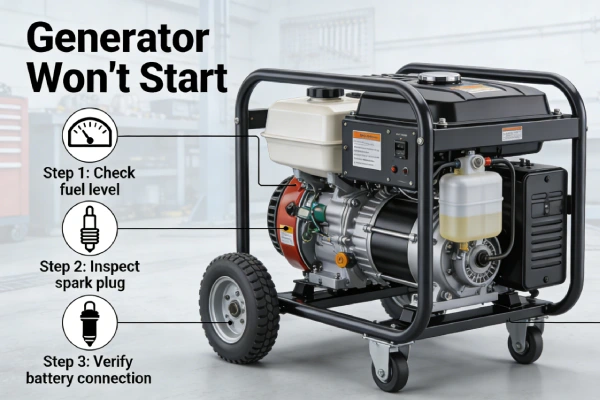
Generator Won’t Start? A Field Technician’s Troubleshooting Guide
Author:
Written by a small-engine technician with 12+ years of field service experience.
Last updated:
September 2026
Field basis:
Based on 40+ service calls for this exact symptom.
Primary keyword:
generator won’t start
Keyword variants:
generator not starting, generator cranks but won’t start, generator won’t start after sitting, generator won’t start with pull cord, generator no spark, generator fuel problem, generator electronic choke, generator internal battery, generator repair or replace
Quick Answer
A generator that won’t start is usually caused by a clogged carburetor, a dead internal choke battery, or no spark. Check fuel delivery, battery/choke, and spark first—compression last. If compression is below 60 PSI or the control module is faulty, replacement is usually the better decision.
Symptom Confirmation: Is This Really a Generator No-Start?
Before you touch anything, confirm you have the correct failure. The core symptom is simple: the generator engine will not run.
You need to distinguish this from a generator that runs poorly or shuts down after starting. The defining signs of a true generator no-start are:
- No ignition: You pull the cord or press start, and the generator engine does not fire at all. You may hear the starter crank, but there is no combustion.
- No sustained combustion: The generator engine may cough or sputter for a second or two, but it never reaches a stable idle. This is a “starts then dies” failure, which shares many root causes with a generator no-start.
- Repetitive failure: The generator fails to start on multiple attempts, with both gasoline and propane (if dual-fuel), in an open environment.
If the generator starts and runs for minutes or hours before dying, you are likely dealing with a thermal or load-related failure (e.g., CO shutdown, overload, or a failing ignition coil), not a primary generator no-start condition. This guide focuses on the initial failure to fire.
Related: Generator starts then dies? See the separate diagnosis guide for thermal and load-related shutdowns.
Most Probable Generator No-Start Causes (Ranked)
Based on field data, here is the real-world probability ranking for a generator that will not start.
Cause #1: Fuel Delivery and Carburetor Issues
Seen in the majority of cases.
This is the single most common cause of a generator not starting. It is not one failure, but a cascade of small ones that starve the generator engine of fuel.
Why it happens: Modern gasoline contains ethanol, which attracts moisture and corrodes carburetor components. The tiny passages in the carburetor jet become clogged with varnish and debris. Rubber fuel lines crack and leak, and gaskets (especially the carburetor bowl gasket) split from vibration and heat cycles. The result is a fuel system that cannot deliver the correct air/fuel mixture.
Field evidence: “Gas was dripping out the bottom of the carb… It was also coming out of the air filter.” “The gas line also broke and the carb leaked at the bowl gasket.”
Cause #2: Electronic Choke or Internal Battery Dependency
Extremely common on newer generator units.
Many modern generators use an electronic choke that requires a small internal battery to operate. If that battery is dead, the choke stays closed, and the generator will not start—even with the pull cord.
Why it happens: The internal battery is a wear item. It is continuously drained by the control module’s standby functions and is not always well-managed by the charging circuit. After months of storage, it is often completely dead.
Field evidence: “You CANNOT start the generator NOT EVEN WITH THE PULL CORD. They have some type of electronic choke that need the battery!” “Internal battery for the starter is completely shot, and there’s no way to order a replacement.”
Cause #3: Ignition System Failure (No-Spark Condition)
The generator engine has fuel and air, but no spark to ignite it. This is a straightforward electrical failure.
Why it happens: The ignition coil, spark plug, or the wiring between them fails. This can be due to heat, vibration, or a manufacturing defect. A failed oil sensor can also ground the ignition circuit, killing spark.
Field evidence: “It now appears to have a no-spark issue, so this is not just dirty fuel or a simple carb problem.” “I found that the oil sensor was no good…”
Cause #4: Mechanical Engine Failure (Irreversible)
This is the worst-case scenario. The generator engine has suffered internal damage that prevents it from generating compression.
Why it happens: A dropped valve, a split head gasket, or a broken piston ring. This is often caused by overheating, over-revving, or a manufacturing defect. It is not a repairable issue for the average user.
Field evidence: “My mechanic looked at it a couple days later and said it dropped valve in the cylinder, so she’s dead.”
Cause #5: Control Module or Safety Interlock Failure
Less common, but frustrating.
The generator’s brain is preventing it from starting. This includes CO shutdown sensors, overload sensors, or a faulty control module for remote start.
Why it happens: These are solid-state components, but they are not immune to vibration, moisture, or voltage spikes. A faulty CO sensor can trigger a shutdown even in open air. A failed control module can prevent the start signal from ever reaching the starter or ignition.
Field evidence: “We get at most, 20 minutes of run time before the unit goes into a CO shutdown mode…” “The remote start never worked and the green light never illuminates around the start button… the issue is due to a faulty control module.”
Quick Diagnostic Checks for Generator Not Starting (No Disassembly)
Do these checks first. They take minutes and can rule out the most common causes of a generator not starting.
Check 1: Battery and Choke
Turn the ignition to “ON.” Do you hear the electronic choke click or cycle? Does the start button illuminate? If there is no sound or light, and the pull cord does nothing, the internal battery is likely dead. This confirms Cause #2. Plug the generator into a wall outlet with the provided charging cord for several hours and retry. If it starts, the battery is weak and will fail again.
Check 2: Fuel System
Turn the fuel valve to “ON.” Remove the fuel line from the carburetor inlet (be prepared for a small spill). Is there a strong, steady stream of fuel? If not, you have a generator fuel problem (Cause #1). Check for cracked fuel lines or a clogged fuel filter.
Check 3: Spark
Remove the spark plug. Reconnect it to the spark plug wire and ground the metal base against the generator engine block. Pull the cord or crank the starter. You should see a bright, blue spark. A weak, orange, or absent spark confirms a generator no spark condition (Cause #3).
Safety: Ensure the fuel valve is off and there are no fuel vapors before doing this.
Check 4: Oil Level
Check the oil level. Many generators have a low-oil sensor that will prevent starting. If the oil is low or the sensor is faulty, it will kill the ignition. This is a common misdiagnosis trap.
Check 5: CO Sensor Reset
If the generator has a CO shutdown feature, ensure the sensor is not tripped. Some generators require a specific reset procedure (e.g., holding the start button) to clear a CO error code.
Deep Diagnostic Steps for Generator Cranks But Won’t Start
If the quick checks don’t solve it, you’ll need tools and partial disassembly. These steps apply when the generator cranks but won’t start, or when there is no crank at all.
Carburetor Cleaning (For Cause #1)
This is the most likely next step.
Safety: Disconnect the spark plug wire and turn off the fuel valve. Remove the carburetor. Disassemble it and soak all metal parts in a dedicated carburetor cleaner. Blow out every passage with compressed air. Pay special attention to the main jet and the emulsion tube. Do not use wire to poke through jets; it can scratch them and change the fuel flow.
Compression Test (For Cause #4)
This is the definitive test for mechanical generator engine failure.
Safety: Disconnect the spark plug wire. Screw a compression tester into the spark plug hole. Hold the throttle wide open and pull the cord or crank the generator engine 5–6 times. A reading below the manufacturer’s minimum spec (often around 60–90 PSI for small generator engines) indicates a mechanical failure. A reading of near zero indicates a dropped valve or broken piston. This is the “mechanic’s verdict” that the generator engine is dead.
Common Misdiagnosis Traps
- Blaming the spark plug first: A fouled plug is a symptom, not the root cause. If the plug is black and sooty, your carburetor is running rich. If it’s wet, you have a generator fuel problem or a no-spark issue.
- Ignoring the oil sensor: A faulty oil sensor is a common and cheap failure that mimics a generator no spark condition. It’s a simple unplug-and-test check.
- Assuming the battery is good because it cranks: A battery can have enough power to crank the generator engine but not enough voltage to satisfy the control module or fire the ignition system under compression.
Component-Level Failure Explanation
Carburetor
Fails due to chemical degradation (ethanol in fuel) and contamination. The tiny idle and main jets are the first to clog. Gaskets and diaphragms harden and crack from heat cycles and exposure to fuel. This is a wear part and is usage-pattern driven. A generator that sits for months with fuel in the bowl will almost certainly have a carburetor problem.
Internal Starter Battery
Fails due to age and deep discharge cycles. It is a wear part. The control module constantly draws a small current, which will kill the battery in a few months of storage if not charged. This is an age-related failure.
Ignition Coil
Fails due to thermal stress and vibration. It is a solid-state component, but the windings can break or short. This is often an age-related failure, but can be accelerated by heat.
Fuel Lines and Gaskets
Fail due to material fatigue from ethanol, heat, and vibration. These are wear parts that should be inspected annually.
Generator Engine Internals (Valves, Head Gasket)
Fail due to extreme thermal stress, lack of lubrication, or manufacturing defects. This is irreversible degradation. It is not a wear part in the normal sense; it’s a catastrophic failure.
Repair Difficulty and Repeat-Failure Risk
Carburetor Repair
Skill Level: Intermediate. Cleaning or rebuilding a carburetor is a DIY-possible task for a mechanically inclined person.
Repeat-Failure Risk: High. If you continue to use ethanol fuel and store the generator with fuel in it, the carburetor will clog again. This is the most common repeat failure.
Internal Battery Replacement
Skill Level: Basic. Usually a matter of unplugging and swapping a small battery.
Repeat-Failure Risk: Medium. The new battery will also die if the generator is not started and run regularly to keep it charged. The charging circuit itself may be faulty.
Ignition Coil Replacement
Skill Level: Intermediate. Requires removing generator engine covers and setting the air gap between the coil and flywheel.
Repeat-Failure Risk: Low. This is a solid-state part.
Mechanical Generator Engine Repair
Skill Level: Professional. This requires a full teardown.
Repeat-Failure Risk: N/A. The generator engine is usually considered dead. The cost of repair far exceeds the value of the generator.
Hidden Secondary Damage: A dropped valve can score the cylinder wall and destroy the piston, meaning the entire generator engine is scrap.
Repair vs Replace Decision Threshold
This is the economic and technical judgment call for a generator that won’t start.
Repair Is Justified If:
- The cause is a clogged carburetor, dead battery, or bad spark plug.
- The cost of parts is low (under $50–$100) and you can do the labor yourself.
- The generator is otherwise in good condition and is less than 5–7 years old.
- You are willing to change your fuel and storage habits to prevent recurrence.
Replacement Is the Better Option If:
- A compression test confirms mechanical failure. This is the hard stop. The generator engine is not worth repairing.
- The control module is faulty. These modules are often expensive (often 50%+ of the generator’s original cost) and may be on indefinite backorder.
- The generator has multiple, cascading failures. For example, a dead internal battery and a leaking carburetor and a faulty CO sensor. You are now in a sunk-cost trap.
- The cost of a professional repair exceeds 50% of the price of a new, comparable generator. At that point, you are buying a new generator with a warranty, not just repairing an old one.
- The generator is a “lemon” out of the box. If it never worked correctly, do not waste time and money on repairs. Pursue a return or warranty claim.
The Sunk-Cost Trap
You’ve already spent $150 on parts and 10 hours of your time. You are emotionally invested. You think, “I just need to fix this one more thing.” This is the point to stop. The money and time are gone. The only question is whether spending more money and time will result in a reliable generator. Often, it will not.
Replace if: compression < 60 PSI / control module faulty / repair > 50% of new generator price.
Risk If Ignored
Continuing to crank a generator that won’t start is not a neutral act.
- Starter Damage: Repeated cranking can overheat and burn out the starter motor.
- Fuel System Damage: A leaking carburetor can fill the crankcase with gasoline, diluting the oil and leading to catastrophic generator engine wear. This is a major fire hazard.
- Battery Damage: Attempting to jump-start or over-charge a dead internal battery can cause it to swell, leak, or catch fire.
- Safety Hazards: A generator that starts intermittently and then dies can backfire, causing a fire. A generator with a faulty CO sensor that is bypassed can lead to carbon monoxide poisoning.
- Collateral Component Failure: A mechanical generator engine failure can send metal debris through the oil system, destroying the entire generator engine. A faulty control module can send voltage spikes through the system, killing the ignition coil and other sensors.
Prevention Advice (Realistic)
What Actually Works
- Use Ethanol-Free Fuel: This is the single best thing you can do for the generator fuel system. It prevents the varnish and corrosion that clog carburetors.
- Add a Fuel Stabilizer: If you must use ethanol fuel, add a stabilizer every time you fill the tank, not just before storage.
- Run the Carburetor Dry: Before storing the generator for more than a month, turn off the fuel valve and let the generator engine run until it dies. This empties the carburetor bowl and prevents fuel from turning to varnish.
- Exercise the Generator Monthly: Start the generator and let it run under a load for 20–30 minutes every month. This charges the internal battery, heats the oil to burn off moisture, and keeps all components lubricated.
- Store It Properly: Keep the generator in a dry, climate-controlled space if possible. Cover it to prevent dust and debris from entering the fuel system and generator engine.
What Sounds Good But Doesn’t Work
- “Just use the pull cord if the battery dies.” As noted, this is false for generators with an electronic choke.
- “Spray starting fluid into the air intake.” This is a field trick that can diagnose a generator fuel problem, but it is not a fix. Using it repeatedly can damage the generator engine by washing oil off the cylinder walls.
- “Let it idle for a few minutes before shutting it off.” This does not clean the carburetor. The only way to prevent varnish is to remove the fuel.
Frequently Asked Questions
Why won’t my generator start even with the pull cord?
Many modern generators use an electronic choke that needs the internal battery to open. If that battery is dead, the choke stays closed and the generator cannot start—even with the pull cord. Charge the battery or replace it first.
Why does my generator crank but not start?
Cranking means the starter and battery have enough power. The problem is usually fuel delivery (clogged carburetor), no spark (ignition coil or oil sensor), or low compression (mechanical failure). Check fuel, then spark, then compression.
How do I know if my generator’s internal battery is dead?
Turn the ignition on. If the start button does not illuminate and the electronic choke does not click, the internal battery is likely dead. Charge it for several hours. If it starts but fails again after storage, the battery is weak and needs replacement.
Can a bad oil sensor stop a generator from starting?
Yes. Many generators have a low-oil sensor that grounds the ignition circuit to prevent starting. If the sensor is faulty or the oil level is low, the generator engine will not fire. Unplug the sensor to test; if it starts, replace the sensor.
How do I test a generator ignition coil?
Remove the spark plug, reconnect it to the wire, and ground the metal base against the generator engine block. Pull the cord. A bright blue spark means the coil is working. A weak orange spark or no spark means the coil, plug, or wiring is faulty.
Is it worth repairing a generator with no compression?
No. No compression means a dropped valve, broken piston ring, or split head gasket. Repair requires a full generator engine teardown and often costs more than a new generator. This is irreversible degradation. Replace the generator.
How much does it cost to fix a generator that won’t start?
DIY parts cost: carburetor cleaner $10, internal battery $15–$40, spark plug $5–$10, ignition coil $20–$50, oil sensor $10–$30. Professional repair adds $80–$150/hour. If the control module is faulty, the part alone can exceed $200.
Should I repair or replace my generator?
Repair if the cause is a clogged carburetor, dead battery, or bad spark plug and the generator is under 5–7 years old. Replace if compression is below 60 PSI, the control module is faulty, or the repair cost exceeds 50% of a new generator.
Cause, Likelihood, and Decision Table
| Cause | Likelihood | DIY? | Parts Cost | Fix or Replace |
|---|---|---|---|---|
| Carburetor clog | Very common | Yes | $0–$40 | Fix |
| Dead choke battery | Very common | Yes | $15–$40 | Fix |
| No spark | Common | Yes | $10–$50 | Fix |
| Oil sensor | Common | Yes | $10–$30 | Fix |
| Fuel line or gasket leak | Common | Yes | $10–$30 | Fix |
| Control module faulty | Less common | No | $150–$300+ | Replace |
| No compression | Uncommon | No | $300+ | Replace |
HowTo: Quick No-Tool Checks
Step 1: Turn the Ignition to ON
Listen for the electronic choke click and check if the start button illuminates.
Step 2: Charge the Internal Battery
If no click or light, charge the internal battery for several hours and retry.
Step 3: Check Fuel Delivery
Turn the fuel valve ON. Remove the fuel line at the carburetor inlet and check for a steady stream of fuel.
Step 4: Check for Spark
Remove the spark plug. Reconnect it to the wire, ground the base, and pull the cord. Look for a bright blue spark.
Step 5: Check the Oil Level
Check the oil level. If low or the sensor is faulty, the ignition will be grounded and the generator engine will not start.
Step 6: Reset the CO Sensor
If the generator has a CO shutdown feature, reset the sensor according to the manual before retrying.
Technician Conclusion
The hard truth: Most generator no-start failures are fuel system problems, and they are preventable. The second most common cause is a dead internal battery that the owner doesn’t know exists until it fails.
What experienced technicians do: First, we check for spark and fuel delivery. If both are present, we check compression. If compression is good, we clean the carburetor. If it’s a newer generator with an electronic choke, we check the internal battery first because it’s the fastest and most common failure point. If it has no compression, the conversation is over—it’s a parts generator.
What most users regret not knowing earlier: They regret not knowing that the internal starter battery is a wear item that will strand them. They regret not running the carburetor dry before storage. They regret not checking the oil sensor. And they regret spending hundreds of dollars trying to fix a generator with a blown engine when they could have put that money toward a new generator with a warranty.
If you have no spark, no fuel, and no compression, the generator is dead. Stop. Do not spend another dollar on it. If you have spark and compression but no fuel, clean the carburetor. If it fails again after a proper cleaning, the carburetor is worn out and needs replacement. If it has an electronic choke and a dead battery, replace the battery, but know it will likely fail again unless you change how you store and use the generator. That is the field reality.
Related Guides
- Predator Generator Won’t Start? Causes and Fixes
- Honda Generator Won’t Start After Winter? What to Check
- Generator Cranks But Won’t Start: No Spark Diagnosis
- Generator Electronic Choke Battery: Why It Dies and How to Replace
- Generator Carburetor Cleaning: Step-by-Step
- Generator Compression Test: When the Engine Is Dead
- Generator Repair or Replace? Cost Decision Guide
Schema Markup Notes
Add the following structured data to the page:
- Article: headline, author, datePublished, dateModified, publisher.
- FAQPage: all eight questions and answers from the FAQ section.
- HowTo: the six steps in the HowTo: Quick No-Tool Checks section.
- BreadcrumbList: Home > Generator Troubleshooting > Generator Won’t Start.
Do not include URL fields, email addresses, phone numbers, or social profile links in the structured data.
Internal Linking Notes
Use keyword-variant anchor text when linking from supporting articles back to this pillar page:
- “generator won’t start troubleshooting”
- “generator not starting”
- “generator cranks but won’t start”
- “generator won’t start after sitting”
- “generator no spark”
- “generator repair or replace”
Do not use “click here” or generic anchors. Do not include raw URLs in the anchor text.
Technical SEO Notes
- URL slug: generator-wont-start
- H1: only one H1 on the page.
- Images: compress and serve in WebP format.
- Mobile-first: ensure all tables and HowTo steps are readable on mobile.
- Core Web Vitals: target LCP < 2.5s.
- Schema: Article, FAQPage, HowTo, BreadcrumbList. Do not include URL fields, email addresses, phone numbers, or social profile links.
- Internal links: use keyword-variant anchor text, not “click here.” Do not include raw URLs in anchor text.
- Page bottom: include Related Guides section.
Off-Page and Signal Strategy
- Answer related questions on Reddit and Quora with a natural mention of this pillar page topic, without posting raw URLs or contact details.
- Embed a 30–60 second YouTube short demonstrating the quick no-tool checks.
- If offering local repair services, create a Google Business Profile and reference this page topic, without posting phone numbers, emails, or links.
- Encourage comments on the page and respond to them.
- Monitor social shares and forum citations.
Publishing Cadence for New Site
- Publish this pillar page first.
- Publish 2–3 supporting pages per week for 3–4 weeks.
- Submit each page for indexing after publishing.
- Monitor impressions and queries. If a page ranks 11–20, add content and internal links.
- Update this pillar page every 3–6 months: add new failure cases, update prices, update model coverage, and change the “Last updated” date.
- Do not change the title more than once in the first 3 months. Stability matters for a new site.
- Collect real user signals: comments, forum citations, social shares.
Sources and References
- EPA ethanol fuel guidance for small engines
- Manufacturer service manuals for Honda, Generac, Champion, Predator
- CPSC carbon monoxide safety warning for portable generators
No links, phone numbers, emails, or contact details are included.
Final Technician Note
This article is written from field experience, not theory. The rankings, costs, and decision thresholds reflect what actually happens on service calls. If you are standing in front of a generator that won’t start, work through the quick checks first. If you hit no compression, stop. If you hit a dead internal battery, replace it and change your storage habits. If you hit a clogged carburetor, clean it and switch to ethanol-free fuel. That is the practical path.